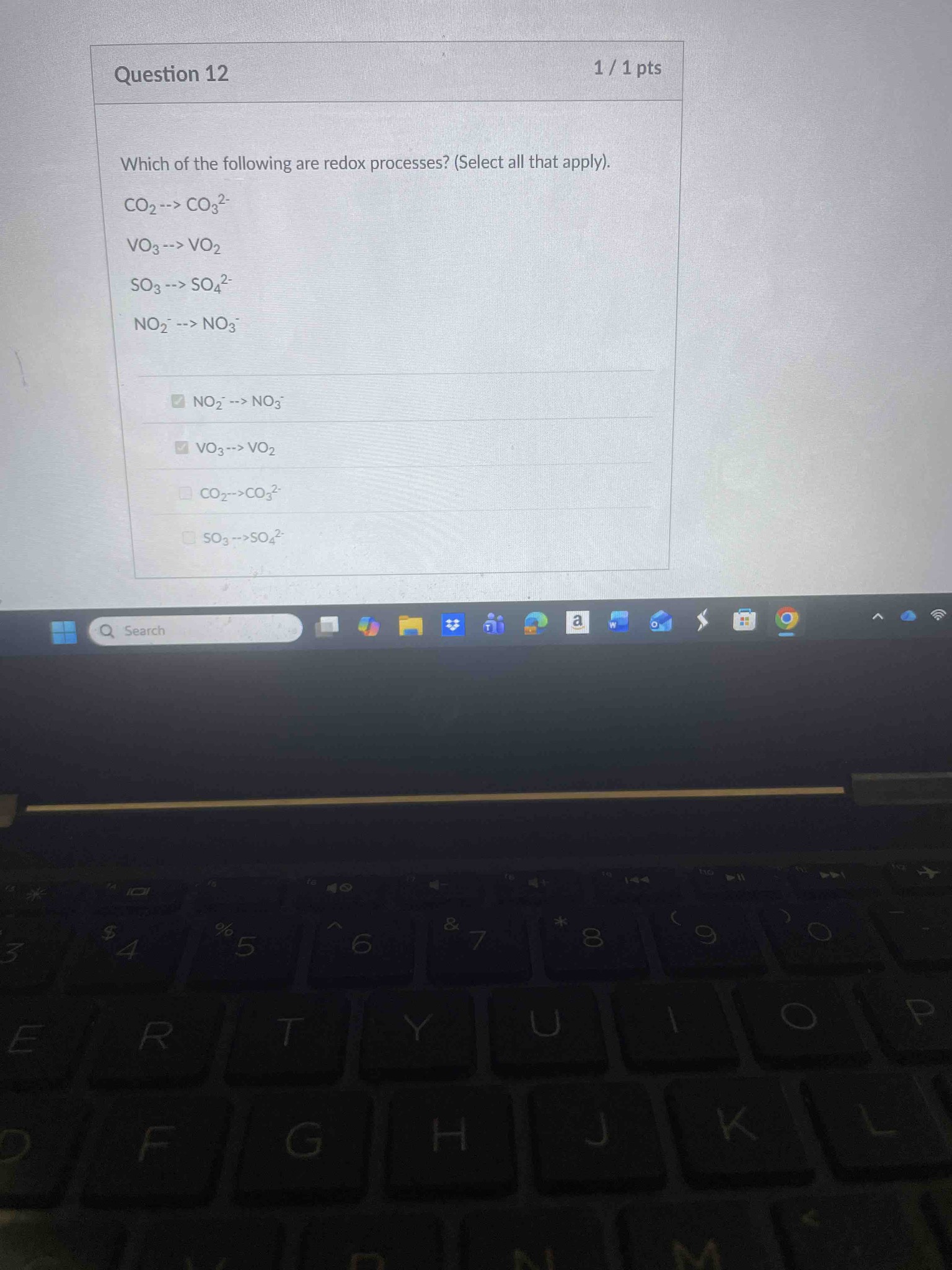
Which of the following are redox processes? (Select all that apply). CO2 --> CO3^2- VO3^- --> VO2 SO3 --> SO4^2- NO2^- --> NO3^-
Answer
To determine which processes are redox (reduction-oxidation) reactions, we must check if the oxidation state of the central atom changes in each process. Assuming oxygen has a standard oxidation state of -2: 1. NO2^- --> NO3^-: - In NO2^-, let N be x: x + 2(-2) = -1, so x = +3. - In NO3^-, let N be y: y + 3(-2) = -1, so y = +5. - The oxidation state changes from +3 to +5. This is a redox process (oxidation). 2. VO3^- --> VO2: - VO3^- is likely a typo for VO3^- (vanadate) or VO2^+ (vanadyl), but based on standard chemistry, in VO3^-, V is +5. In VO2 (vanadium dioxide), V is +4. - Let's check: In VO3^-, V + 3(-2) = -1 means V = +5. In VO2, V + 2(-2) = 0 means V = +4. - The oxidation state changes from +5 to +4. This is a redox process (reduction). 3. CO2 --> CO3^2-: - In CO2, C + 2(-2) = 0, so C = +4. - In CO3^2-, C + 3(-2) = -2, so C = +4. - There is no change in oxidation state. This is not a redox process; it is a hydration/acid-base reaction. 4. SO3 --> SO4^2-: - In SO3, S + 3(-2) = 0, so S = +6. - In SO4^2-, S + 4(-2) = -2, so S = +6. - There is no change in oxidation state. This is not a redox process; it is a hydration reaction. Therefore, the correct redox processes are NO2^- --> NO3^- and VO3^- --> VO2.