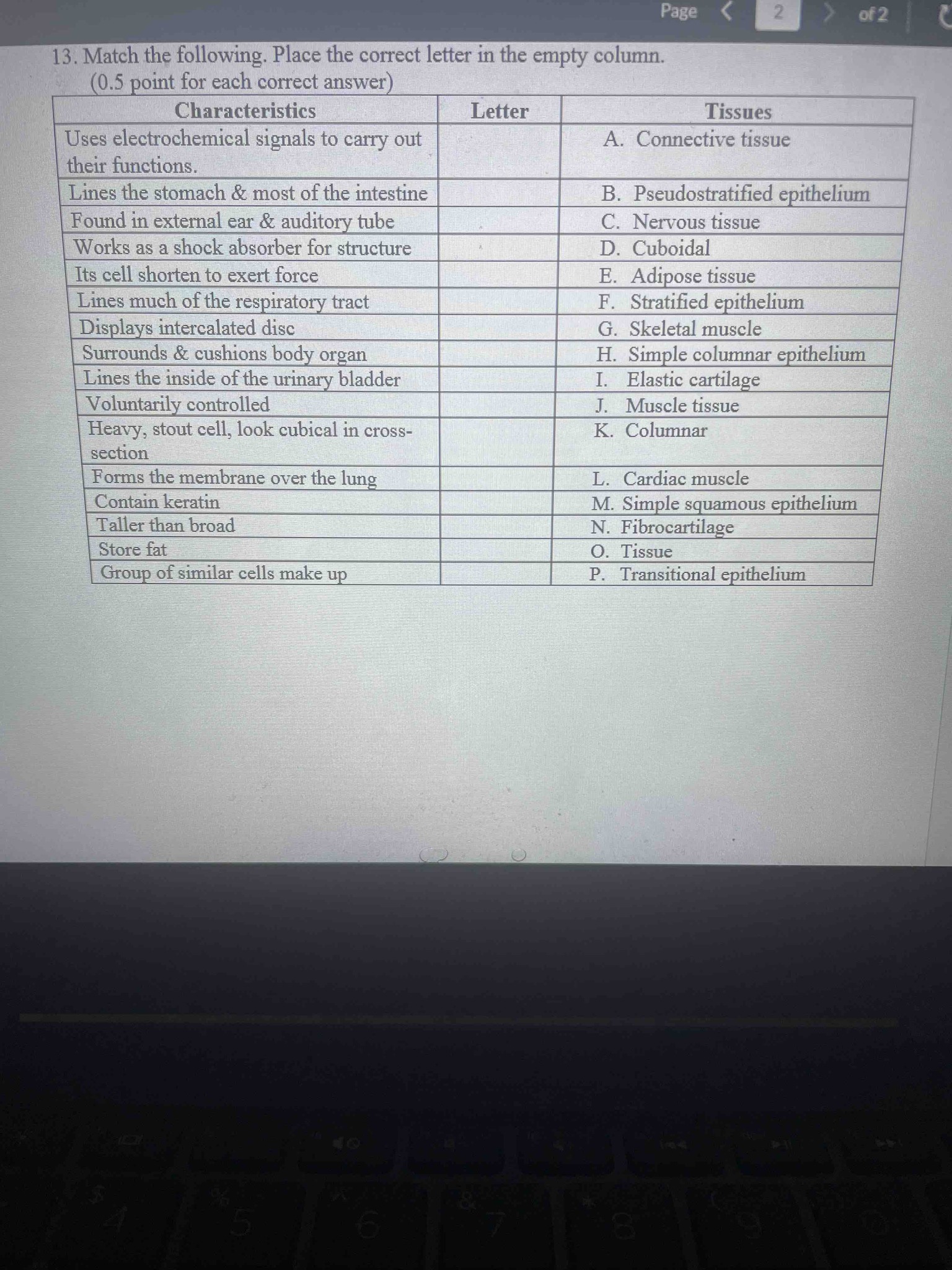
13. Match the following. Place the correct letter in the empty column. Characteristics: 1. Uses electrochemical signals to carry out their functions. 2. Lines the stomach & most of the intestine. 3. Found in external ear & auditory tube. 4. Works as a shock absorber for structure. 5. Its cell shorten to exert force. 6. Lines much of the respiratory tract. 7. Displays intercalated disc. 8. Surrounds & cushions body organ. 9. Lines the inside of the urinary bladder. 10. Voluntarily controlled. 11. Heavy, stout cell, look cubical in cross-section. 12. Forms the membrane over the lung. 13. Contain keratin. 14. Taller than broad. 15. Store fat. 16. Group of similar cells make up. Tissues: A. Connective tissue, B. Pseudostratified epithelium, C. Nervous tissue, D. Cuboidal, E. Adipose tissue, F. Stratified epithelium, G. Skeletal muscle, H. Simple columnar epithelium, I. Elastic cartilage, J. Muscle tissue, K. Columnar, L. Cardiac muscle, M. Simple squamous epithelium, N. Fibrocartilage, O. Tissue, P. Transitional epithelium.
Answer
The correct mapping for each characteristic to its tissue is as follows: 1. Uses electrochemical signals to carry out their functions -> C. Nervous tissue (Specialized for communication via electrical signals). 2. Lines the stomach & most of the intestine -> H. Simple columnar epithelium (Allows for secretion and absorption in the GI tract). 3. Found in external ear & auditory tube -> I. Elastic cartilage (Provides flexibility and maintains shape). 4. Works as a shock absorber for structure -> N. Fibrocartilage (Strongest cartilage type, found in intervertebral discs). 5. Its cell shorten to exert force -> J. Muscle tissue (General property of all muscle tissues). 6. Lines much of the respiratory tract -> B. Pseudostratified epithelium (Often ciliated to move mucus). 7. Displays intercalated disc -> L. Cardiac muscle (Unique junctions between heart muscle cells). 8. Surrounds & cushions body organ -> A. Connective tissue (General role of loose connective tissues). 9. Lines the inside of the urinary bladder -> P. Transitional epithelium (Can stretch to accommodate volume changes). 10. Voluntarily controlled -> G. Skeletal muscle (Controlled by the somatic nervous system). 11. Heavy, stout cell, look cubical in cross-section -> D. Cuboidal (Shape description). 12. Forms the membrane over the lung -> M. Simple squamous epithelium (Specifically the visceral pleura, facilitating diffusion). 13. Contain keratin -> F. Stratified epithelium (Specifically keratinized stratified squamous epithelium found in skin). 14. Taller than broad -> K. Columnar (Definition of vertical cell shape). 15. Store fat -> E. Adipose tissue (Specialized connective tissue for energy storage). 16. Group of similar cells make up -> O. Tissue (The basic biological definition of a tissue).