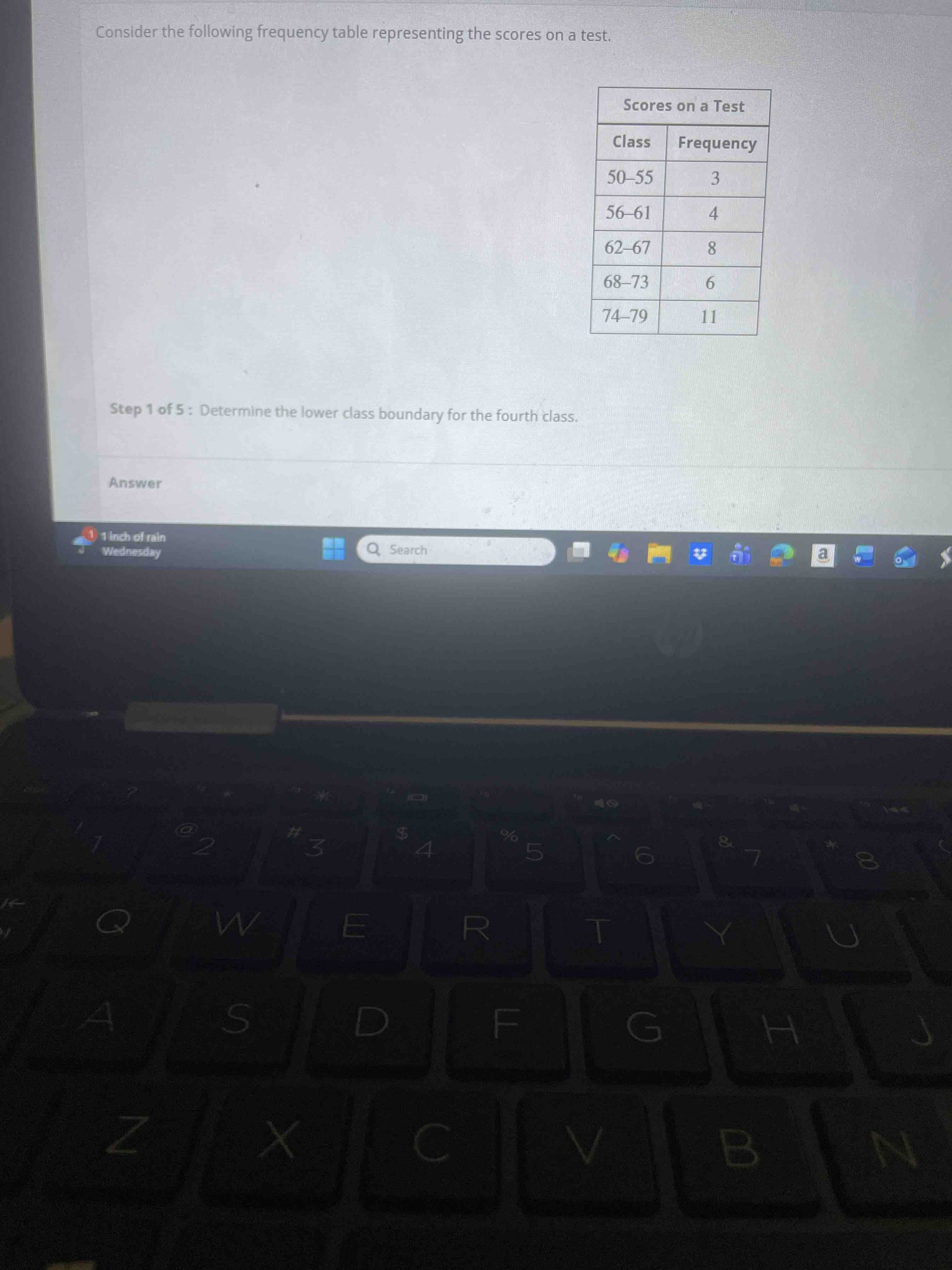
Consider the following frequency table representing the scores on a test. The table includes five classes: 50-55 (frequency 3), 56-61 (frequency 4), 62-67 (frequency 8), 68-73 (frequency 6), and 74-79 (frequency 11). Step 1 of 5: Determine the lower class boundary for the fourth class.
Answer
To find the lower class boundary of a class, you find the midpoint between the lower limit of that class and the upper limit of the preceding class. First, identify the fourth class and its preceding class from the table: The fourth class is 68-73, with a lower limit of 68. The third class (the preceding class) is 62-67, with an upper limit of 67. To find the lower class boundary of the fourth class, calculate the average of its lower limit (68) and the upper limit of the preceding class (67). The formula is (Previous Upper Limit + Current Lower Limit) / 2. Applying the numbers: (67 + 68) / 2 = 135 / 2 = 67.5. Therefore, the lower class boundary for the fourth class is 67.5.