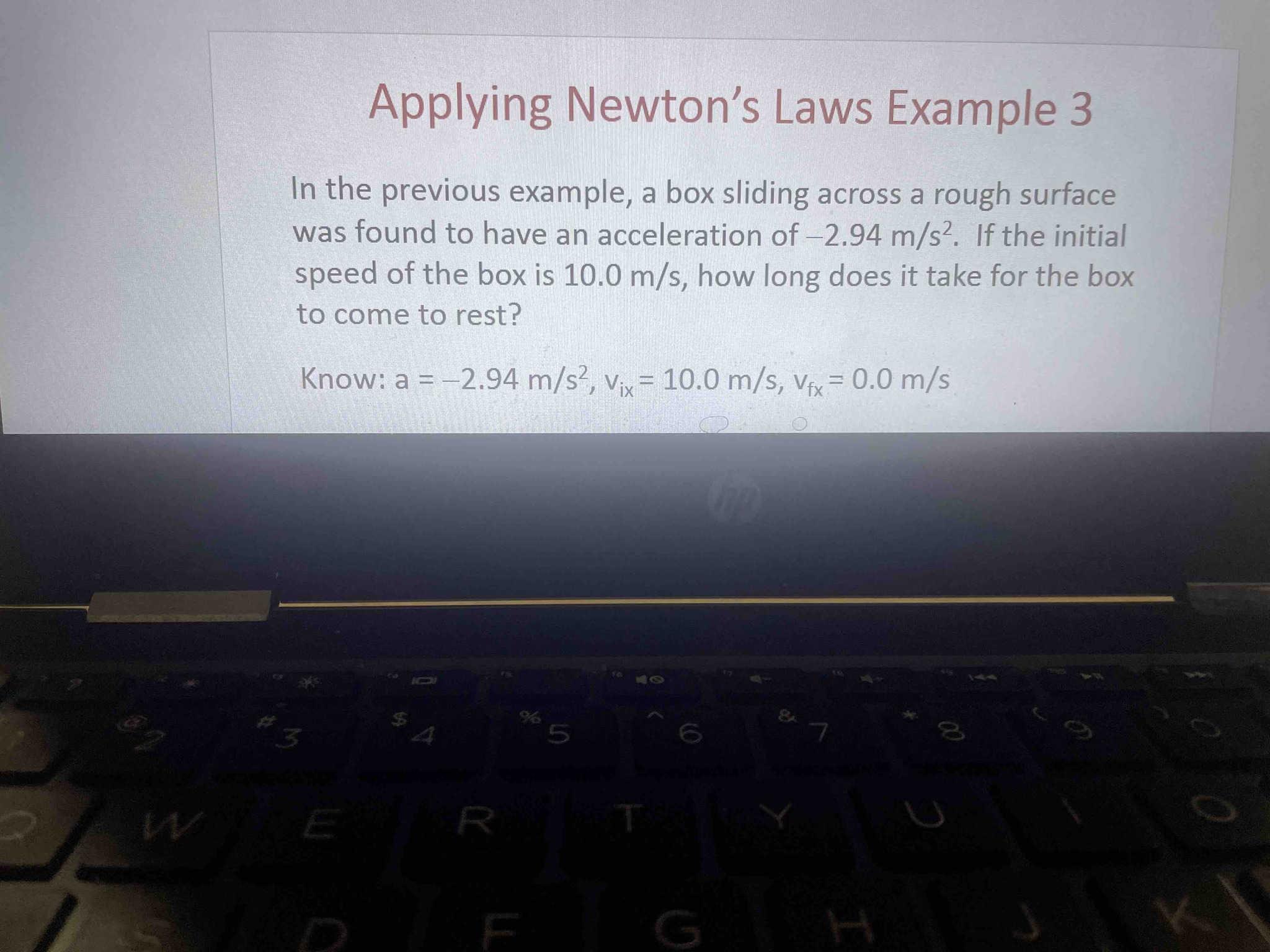
Applying Newton's Laws Example 3. In the previous example, a box sliding across a rough surface was found to have an acceleration of -2.94 m/s^2. If the initial speed of the box is 10.0 m/s, how long does it take for the box to come to rest? Know: a = -2.94 m/s^2, vix = 10.0 m/s, vfx = 0.0 m/s
Answer
To find how long it takes for the box to come to rest, we can use the kinematic equation for motion with constant acceleration: vfx = vix + a * t. Given information: 1. Final velocity (vfx) = 0.0 m/s (since the box comes to rest). 2. Initial velocity (vix) = 10.0 m/s. 3. Acceleration (a) = -2.94 m/s^2. We need to solve for time (t). Rearranging the equation to solve for t gives: t = (vfx - vix) / a. Substituting the given values into the equation: t = (0.0 m/s - 10.0 m/s) / (-2.94 m/s^2). t = (-10.0 m/s) / (-2.94 m/s^2). t ≈ 3.40136... s. Rounding to three significant figures, we get: t = 3.40 seconds. Therefore, it takes approximately 3.40 seconds for the box to come to rest.