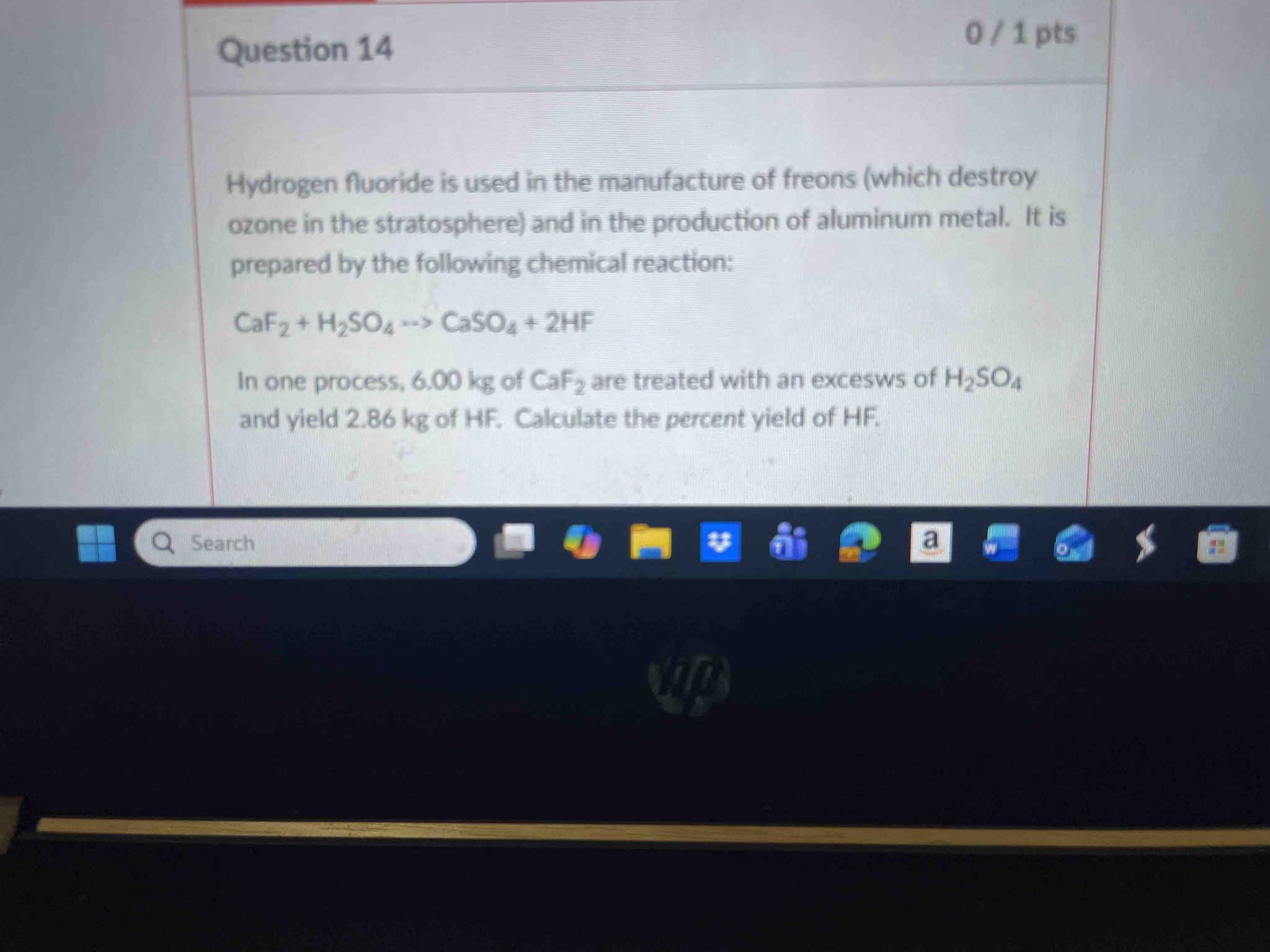
Hydrogen fluoride is used in the manufacture of freons (which destroy ozone in the stratosphere) and in the production of aluminum metal. It is prepared by the following chemical reaction: CaF2 + H2SO4 --> CaSO4 + 2HF. In one process, 6.00 kg of CaF2 are treated with an excess of H2SO4 and yield 2.86 kg of HF. Calculate the percent yield of HF.
Answer
1. Identify the given information: Mass of CaF2 = 6.00 kg = 6000 g. Actual yield of HF = 2.86 kg = 2860 g. The reaction is CaF2 + H2SO4 --> CaSO4 + 2HF. 2. Calculate the molar masses: Molar mass of CaF2 = 40.08 (Ca) + 2 * 19.00 (F) = 78.08 g/mol. Molar mass of HF = 1.008 (H) + 19.00 (F) = 20.008 g/mol. 3. Calculate moles of CaF2: Moles = 6000 g / 78.08 g/mol = 76.844 mol. 4. Determine theoretical yield of HF: According to the balanced equation, 1 mole of CaF2 produces 2 moles of HF. Theoretical moles of HF = 2 * 76.844 mol = 153.688 mol. Theoretical mass of HF = 153.688 mol * 20.008 g/mol = 3074.99 g = 3.075 kg. 5. Calculate percent yield: Percent Yield = (Actual Yield / Theoretical Yield) * 100%. Percent Yield = (2.86 kg / 3.075 kg) * 100% = 93.008%. Rounded to three significant figures, the percent yield is 93.0%.