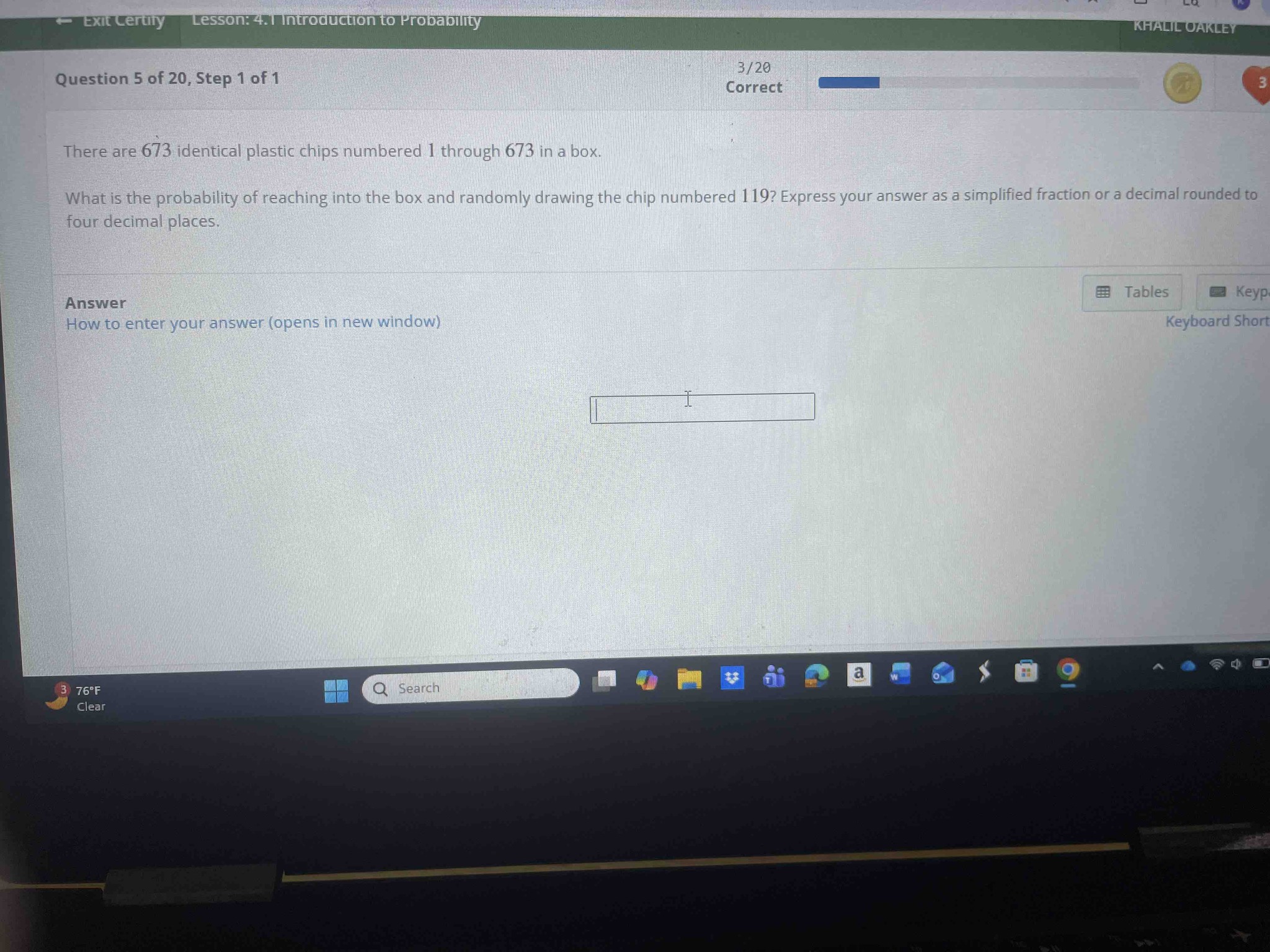
There are 673 identical plastic chips numbered 1 through 673 in a box. What is the probability of reaching into the box and randomly drawing the chip numbered 119? Express your answer as a simplified fraction or a decimal rounded to four decimal places.
Answer
To find the probability of a specific event occurring, we use the basic probability formula: P(Event) = (Number of favorable outcomes) / (Total number of possible outcomes). In this problem, the total number of plastic chips in the box is 673, which represents the total number of possible outcomes since each chip is equally likely to be drawn. We are looking for the probability of drawing one specific chip, the one numbered 119. There is only one chip with the number 119 in the box, so the number of favorable outcomes is 1. Plugging these values into the formula gives us a probability of 1/673. This is already a simplified fraction because 673 is a prime number. To express this as a decimal rounded to four decimal places, we divide 1 by 673, which is approximately 0.00148588. Rounding to the fourth decimal place, we look at the fifth digit (8); since it is 5 or greater, we round up the fourth digit. Therefore, the decimal probability is 0.0015.