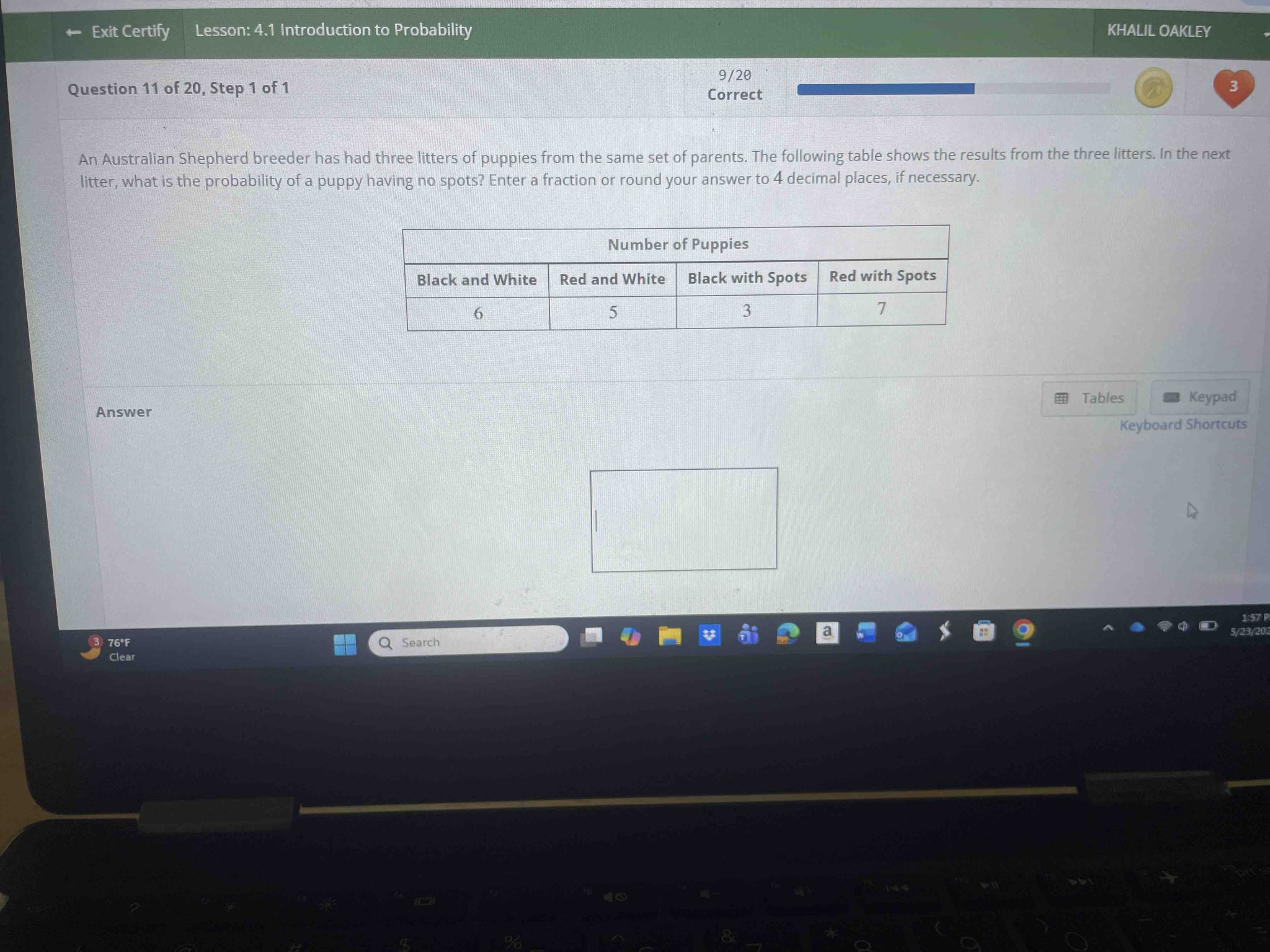
An Australian Shepherd breeder has had three litters of puppies from the same set of parents. The following table shows the results from the three litters. In the next litter, what is the probability of a puppy having no spots? Enter a fraction or round your answer to 4 decimal places, if necessary. The table provides the following counts for 'Number of Puppies': Black and White: 6, Red and White: 5, Black with Spots: 3, Red with Spots: 7.
Answer
To find the probability of a puppy having no spots, we use the empirical probability formula: P(event) = (Number of favorable outcomes) / (Total number of outcomes). Step 1: Identify puppies with no spots. The categories 'Black and White' and 'Red and White' represent puppies without spots. Summing these counts: 6 + 5 = 11 puppies with no spots. Step 2: Calculate the total number of puppies in all litters. Total = 6 (Black and White) + 5 (Red and White) + 3 (Black with Spots) + 7 (Red with Spots) = 21 puppies. Step 3: Calculate the probability. Probability = (Puppies with no spots) / (Total puppies) = 11 / 21. Converting this to a decimal: 11 ÷ 21 ≈ 0.5238095. Rounding to 4 decimal places, we get 0.5238. Therefore, the probability is 11/21 or 0.5238.