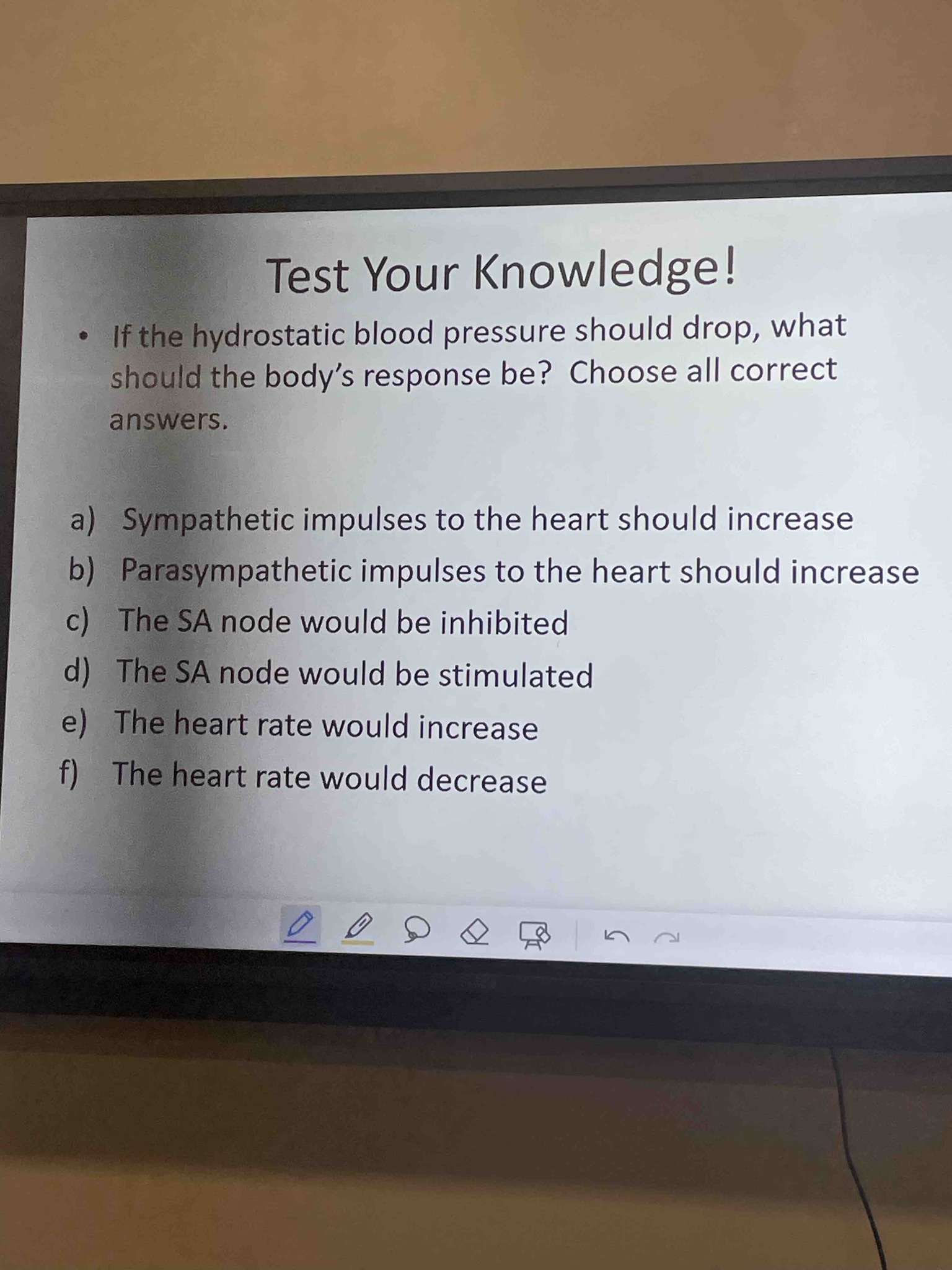
If the hydrostatic blood pressure should drop, what should the body's response be? Choose all correct answers. a) Sympathetic impulses to the heart should increase b) Parasympathetic impulses to the heart should increase c) The SA node would be inhibited d) The SA node would be stimulated e) The heart rate would increase f) The heart rate would decrease
Answer
The correct answers are a, d, and e. When hydrostatic blood pressure drops, the body initiates the baroreceptor reflex to restore homeostasis and maintain adequate blood flow to tissues. 1) Sympathetic impulses increase (a): The cardiovascular control center in the medulla oblongata increases sympathetic nervous system activity. This leads to the release of norepinephrine, which increases both the heart rate and the force of contraction. 2) The SA node is stimulated (d): Sympathetic stimulation specifically targets the sinoatrial (SA) node, the heart's natural pacemaker, causing it to fire more rapidly. 3) The heart rate increases (e): Because the SA node is firing faster due to sympathetic stimulation, the overall heart rate increases. This increase in heart rate helps raise cardiac output, which in turn helps elevate and normalize the blood pressure. Conversely, options b, c, and f describe responses associated with a rise in blood pressure, where the body would attempt to slow the heart down.