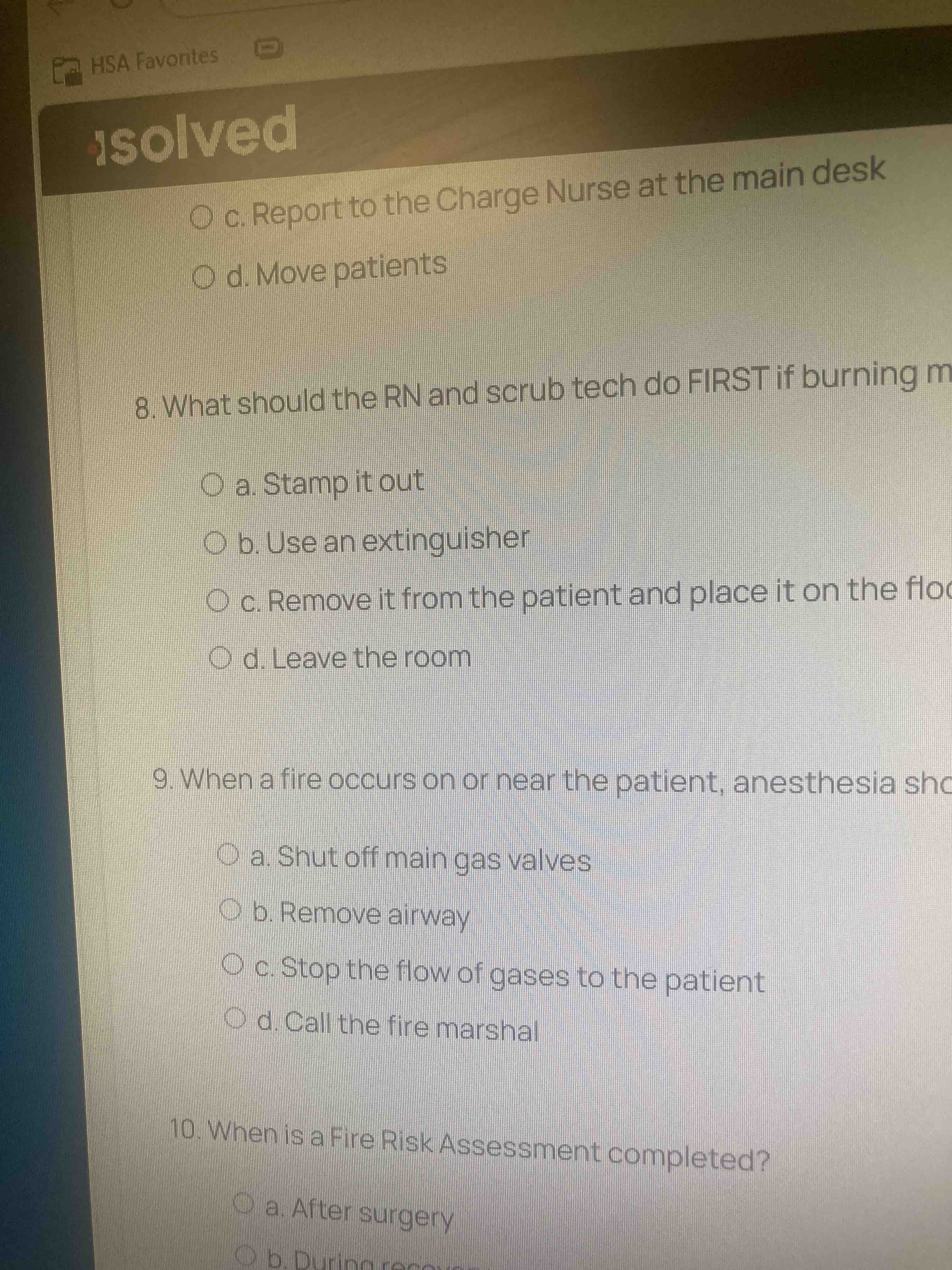
8. What should the RN and scrub tech do FIRST if burning material is found on a patient? Options: a. Stamp it out, b. Use an extinguisher, c. Remove it from the patient and place it on the floor, d. Leave the room. 9. When a fire occurs on or near the patient, anesthesia should: Options: a. Shut off main gas valves, b. Remove airway, c. Stop the flow of gases to the patient, d. Call the fire marshal. 10. When is a Fire Risk Assessment completed? Options: a. After surgery, b. During recovery, c. Before surgery (or preoperatively as implied by surgical safety standards).
Answer
For question 8, the correct answer is c. Remove it from the patient and place it on the floor. In an operating room fire safety scenario, the immediate priority is to stop the burning material from harming the patient directly by removing it. For question 9, the correct answer is c. Stop the flow of gases to the patient. Anesthesia providers must stop the delivery of oxygen and other medical gases that feed the fire. For question 10, a Fire Risk Assessment is typically completed before surgery to identify potential fire hazards in the OR.