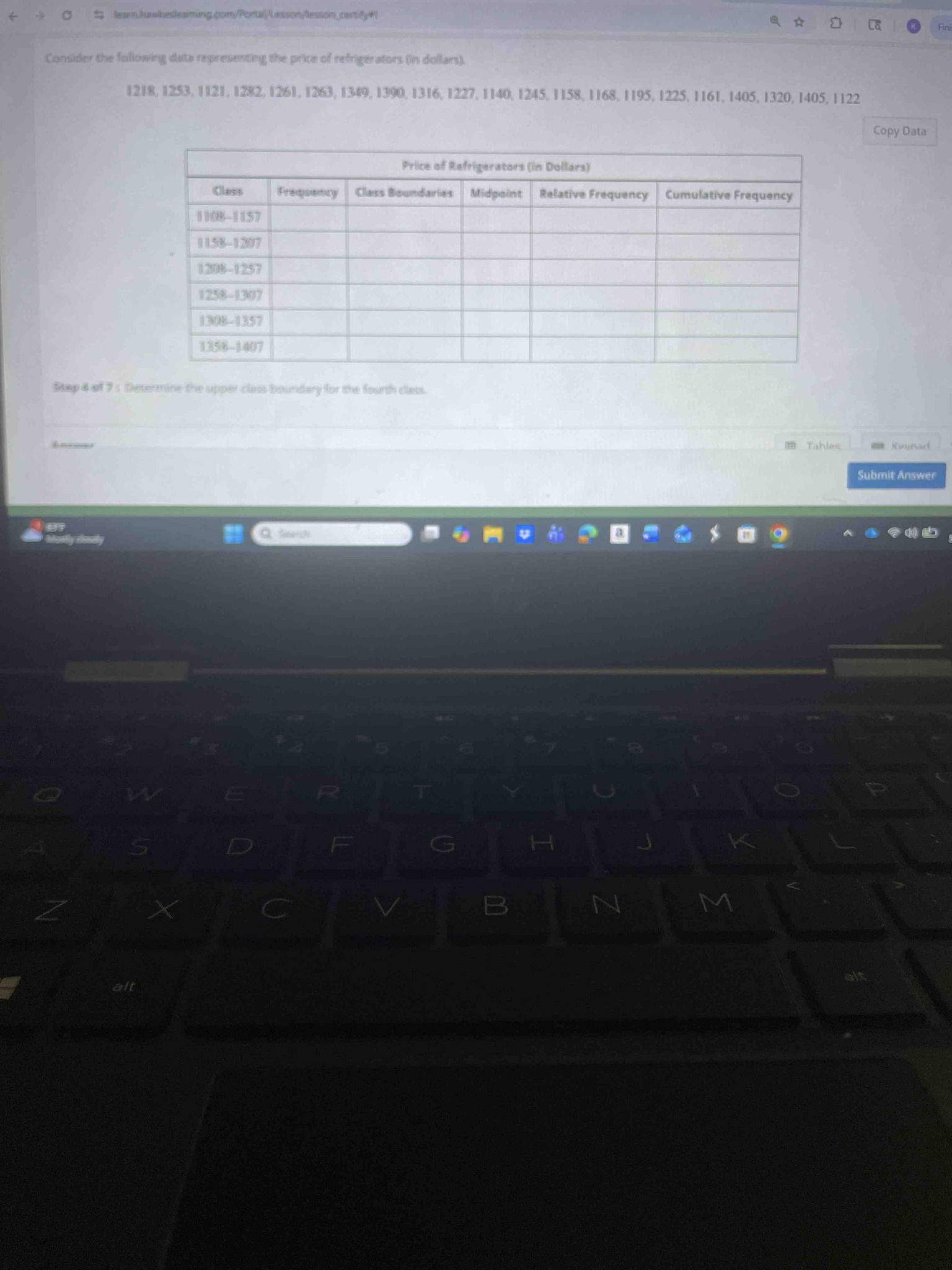
Consider the following data representing the price of refrigerators (in dollars): 1218, 1253, 1121, 1282, 1261, 1263, 1349, 1390, 1316, 1227, 1140, 1245, 1158, 1168, 1195, 1225, 1161, 1405, 1320, 1405, 1122. Step 4 of 7: Determine the upper class boundary for the fourth class.
Answer
To determine the upper class boundary for the fourth class, we first identify the fourth class range from the provided table. The classes are listed as: 1) 1108–1157, 2) 1158–1207, 3) 1208–1257, 4) 1258–1307. The fourth class is 1258–1307. In a frequency distribution with integer limits, class boundaries are the midpoints between the upper limit of one class and the lower limit of the next class. The upper class limit for the fourth class is 1307, and the lower class limit for the fifth class is 1308. To find the boundary, calculate the average of these two values: (1307 + 1308) / 2 = 1307.5. Therefore, the upper class boundary for the fourth class is 1307.5.