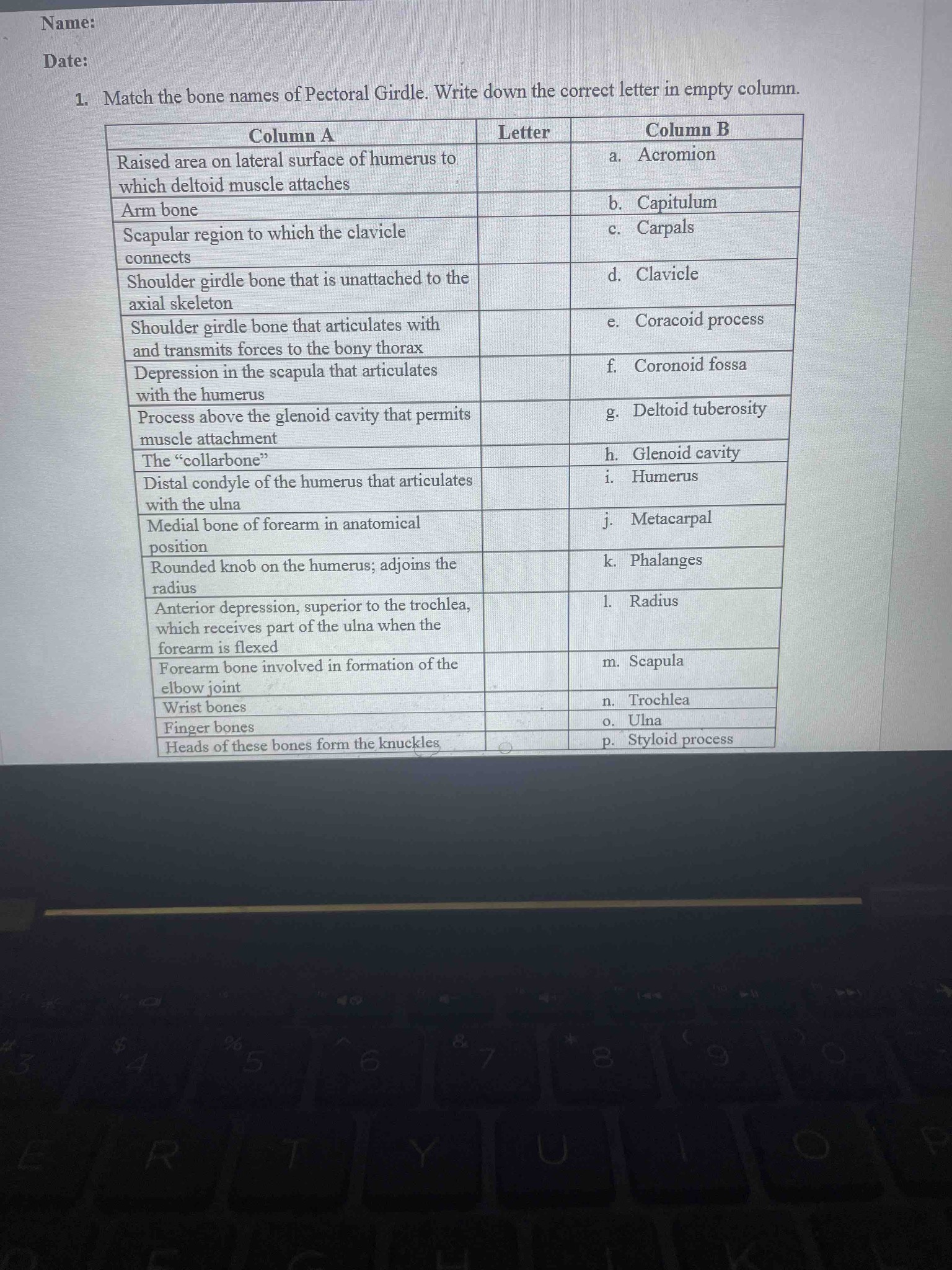
Match the bone names of Pectoral Girdle. Write down the correct letter in the empty column. Column A descriptions: 1. Raised area on lateral surface of humerus to which deltoid muscle attaches. 2. Arm bone. 3. Scapular region to which the clavicle connects. 4. Shoulder girdle bone that is unattached to the axial skeleton. 5. Shoulder girdle bone that articulates with and transmits forces to the bony thorax. 6. Depression in the scapula that articulates with the humerus. 7. Process above the glenoid cavity that permits muscle attachment. 8. The 'collarbone'. 9. Distal condyle of the humerus that articulates with the ulna. 10. Medial bone of forearm in anatomical position. 11. Rounded knob on the humerus; adjoins the radius. 12. Anterior depression, superior to the trochlea, which receives part of the ulna when the forearm is flexed. 13. Forearm bone involved in formation of the elbow joint. 14. Wrist bones. 15. Finger bones. 16. Heads of these bones form the knuckles.
Answer
The correct matches for the pectoral girdle and upper limb anatomy are: 1. Raised area on lateral humerus for deltoid attachment: g (Deltoid tuberosity). 2. Arm bone: i (Humerus). 3. Scapular region connecting to clavicle: a (Acromion). 4. Shoulder girdle bone unattached to axial skeleton: m (Scapula), which is held in place by muscles. 5. Shoulder girdle bone articulating with/transmitting force to bony thorax: d (Clavicle), via the sternoclavicular joint. 6. Depression in scapula articulating with humerus: h (Glenoid cavity). 7. Process above glenoid cavity for muscle attachment: e (Coracoid process). 8. The 'collarbone': d (Clavicle). 9. Distal condyle of humerus articulating with ulna: n (Trochlea). 10. Medial bone of forearm: o (Ulna). 11. Rounded knob on humerus adjoining radius: b (Capitulum). 12. Anterior depression above trochlea for ulna: f (Coronoid fossa). 13. Forearm bone in elbow joint: o (Ulna). 14. Wrist bones: c (Carpals). 15. Finger bones: k (Phalanges). 16. Heads forming knuckles: j (Metacarpal).