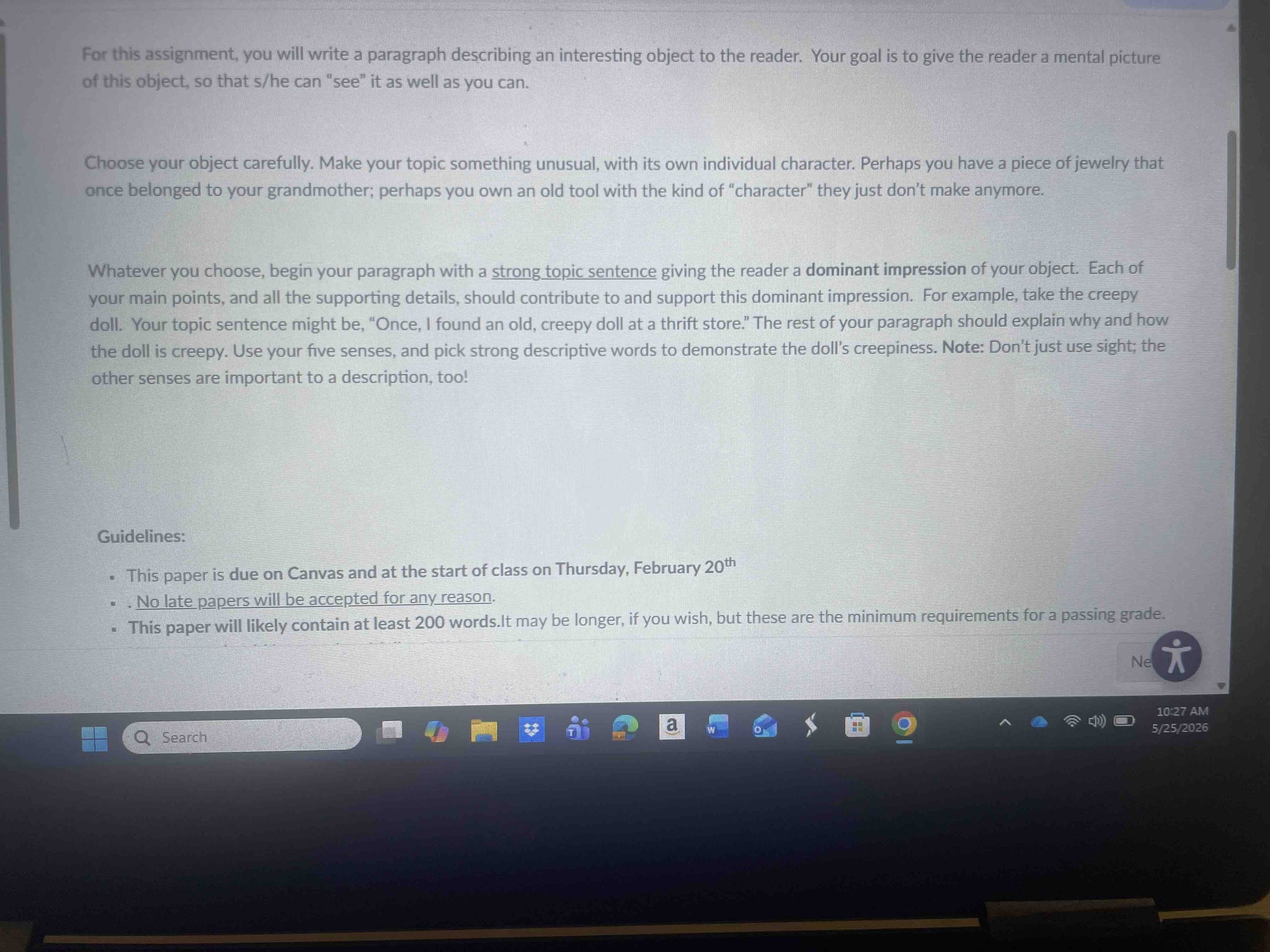
For this assignment, you will write a paragraph describing an interesting object to the reader. Your goal is to give the reader a mental picture of this object, so that s/he can "see" it as well as you can. Choose your object carefully. Make your topic something unusual, with its own individual character. Perhaps you have a piece of jewelry that once belonged to your grandmother; perhaps you own an old tool with the kind of "character" they just don't make anymore. Whatever you choose, begin your paragraph with a strong topic sentence giving the reader a dominant impression of your object. Each of your main points, and all the supporting details, should contribute to and support this dominant impression. For example, take the creepy doll. Your topic sentence might be, "Once, I found an old, creepy doll at a thrift store." The rest of your paragraph should explain why and how the doll is creepy. Use your five senses, and pick strong descriptive words to demonstrate the doll's creepiness. Note: Don't just use sight; the other senses are important to a description, too! Guidelines: This paper is due on Canvas and at the start of class on Thursday, February 20th. No late papers will be accepted for any reason. This paper will likely contain at least 200 words. It may be longer, if you wish, but these are the minimum requirements for a passing grade.
Answer
To successfully complete this descriptive writing assignment, follow these steps: 1. Selection: Choose a specific, physical object that has unique characteristics. Examples include a tarnished pocket watch, a weathered leather journal, or a rusted antique key. 2. Topic Sentence: Draft a primary sentence that established the 'dominant impression'—the main feeling or vibe the object gives off (e.g., 'Sitting on my desk is an ancient wooden music box that exudes a sense of forgotten melancholy.'). 3. Sensory Details: List details involving at least three or four senses. Visual: the peeling gold leaf on the edges. Tactile: the rough, splintered texture of the wood. Auditory: the clicking, out-of-tune melody it plays. Olfactory: the faint scent of cedar and dust. 4. Drafting: Write the paragraph (aiming for over 200 words) by expanding on these details. Focus on using specific adjectives instead of vague ones; instead of saying it looks 'old,' say it 'bears the deep, jagged scars of a century of use.' 5. Review: Ensure every sentence reinforces the 'dominant impression' and check that the word count meets the minimum requirement of 200 words before the February 20th deadline.