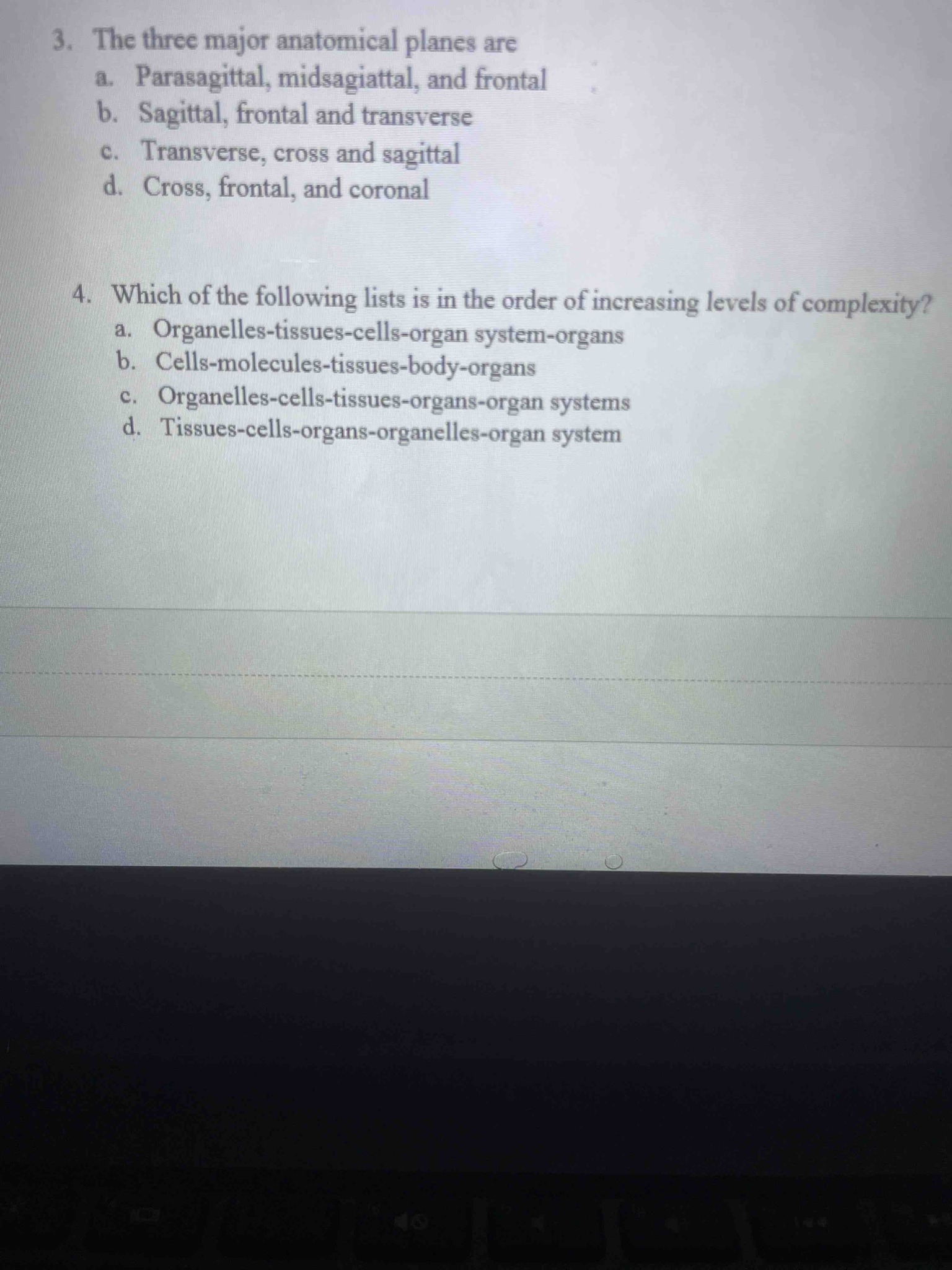
3. The three major anatomical planes are a. Parasagittal, midsagiattal, and frontal b. Sagittal, frontal and transverse c. Transverse, cross and sagittal d. Cross, frontal, and coronal 4. Which of the following lists is in the order of increasing levels of complexity? a. Organelles-tissues-cells-organ system-organs b. Cells-molecules-tissues-body-organs c. Organelles-cells-tissues-organs-organ systems d. Tissues-cells-organs-organelles-organ system
Answer
For question 3, the correct answer is b. Sagittal, frontal and transverse. In anatomy, there are three mutually perpendicular planes that divide the body: the sagittal plane (dividing into left and right), the frontal or coronal plane (dividing into front and back), and the transverse or horizontal plane (dividing into top and bottom). While parasagittal and midsagittal are types of sagittal planes, they are not the general categories. For question 4, the correct answer is c. organelles-cells-tissues-organs-organ systems. Biological organization follows a hierarchy from smallest and simplest to largest and most complex. Organelles (structures inside cells) combine to form a Cell (the basic unit of life). Groups of similar cells form Tissues. Different tissues working together form an Organ (e.g., the heart). Multiple organs working together for a common function form an Organ System (e.g., the circulatory system). Options a, b, and d are incorrect because they place more complex levels before simpler ones.