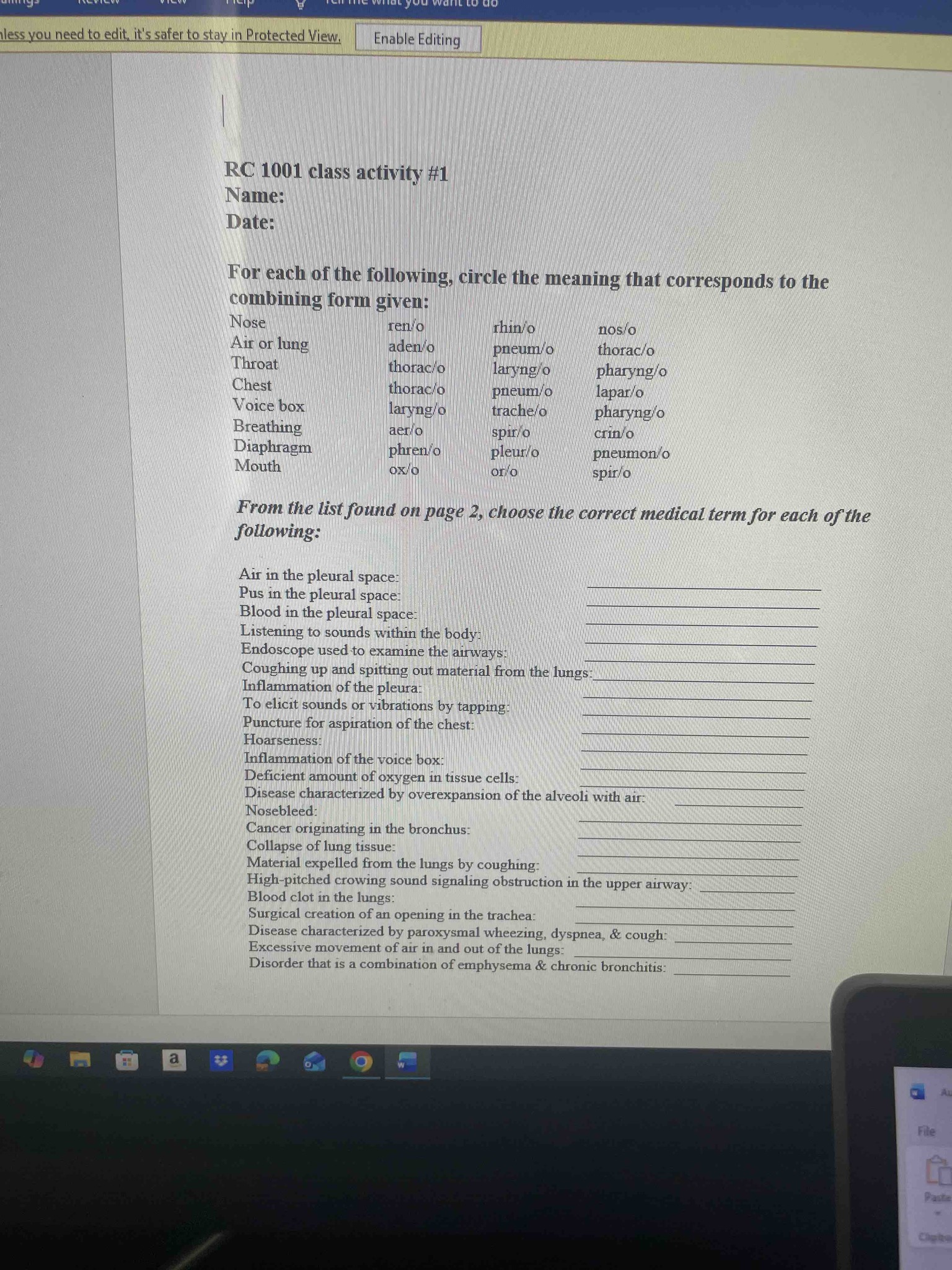
For each of the following, circle the meaning that corresponds to the combining form given: Nose: ren/o, rhin/o, nos/o Air or lung: aden/o, pneum/o, thorac/o Throat: thorac/o, laryng/o, pharyng/o Chest: thorac/o, pneum/o, lapar/o Voice box: laryng/o, trache/o, pharyng/o Breathing: aer/o, spir/o, crin/o Diaphragm: phren/o, pleur/o, pneum/o Mouth: ox/o, or/o, spir/o From the list found on page 2, choose the correct medical term for each of the following: Air in the pleural space: Pus in the pleural space: Blood in the pleural space: Listening to sounds within the body: Endoscope used to examine the airways: Coughing up and spitting out material from the lungs: Inflammation of the pleura: To elicit sounds or vibrations by tapping: Puncture for aspiration of the chest: Hoarseness: Inflammation of the voice box: Deficient amount of oxygen in tissue cells: Disease characterized by overexpansion of the alveoli with air: Nosebleed: Cancer originating in the bronchus: Collapse of lung tissue: Material expelled from the lungs by coughing: High-pitched crowing sound signaling obstruction in the upper airway: Blood clot in the lungs: Surgical creation of an opening in the trachea: Disease characterized by paroxysmal wheezing, dyspnea, & cough: Excessive movement of air in and out of the lungs: Disorder that is a combination of emphysema & chronic bronchitis:
Answer
Here are the solutions based on standard medical terminology: MATCHING COMBINING FORMS: 1. Nose: rhin/o (e.g., rhinoplasty) 2. Air or lung: pneum/o (e.g., pneumonia) 3. Throat: pharyng/o (the pharynx is the throat) 4. Chest: thorac/o (the thorax is the chest) 5. Voice box: laryng/o (the larynx is the voice box) 6. Breathing: spir/o (e.g., spirometry) 7. Diaphragm: phren/o (e.g., phrenic nerve) 8. Mouth: or/o (e.g., oral) MEDICAL TERMS DEFINITIONS: 1. Air in the pleural space: Pneumothorax 2. Pus in the pleural space: Empyema (or Pyothorax) 3. Blood in the pleural space: Hemothorax 4. Listening to sounds within the body: Auscultation 5. Endoscope used to examine the airways: Bronchoscope 6. Coughing up and spitting out material from the lungs: Expectoration 7. Inflammation of the pleura: Pleurisy (or Pleuritis) 8. To elicit sounds or vibrations by tapping: Percussion 9. Puncture for aspiration of the chest: Thoracentesis 10. Hoarseness: Dysphonia 11. Inflammation of the voice box: Laryngitis 12. Deficient amount of oxygen in tissue cells: Hypoxia 13. Disease characterized by overexpansion of the alveoli with air: Emphysema 14. Nosebleed: Epistaxis 15. Cancer originating in the bronchus: Bronchogenic carcinoma 16. Collapse of lung tissue: Atelectasis 17. Material expelled from the lungs by coughing: Sputum 18. High-pitched crowing sound signaling obstruction in the upper airway: Stridor 19. Blood clot in the lungs: Pulmonary embolism 20. Surgical creation of an opening in the trachea: Tracheostomy 21. Disease characterized by paroxysmal wheezing, dyspnea, & cough: Asthma 22. Excessive movement of air in and out of the lungs: Hyperventilation 23. Disorder that is a combination of emphysema & chronic bronchitis: Chronic Obstructive Pulmonary Disease (COPD)