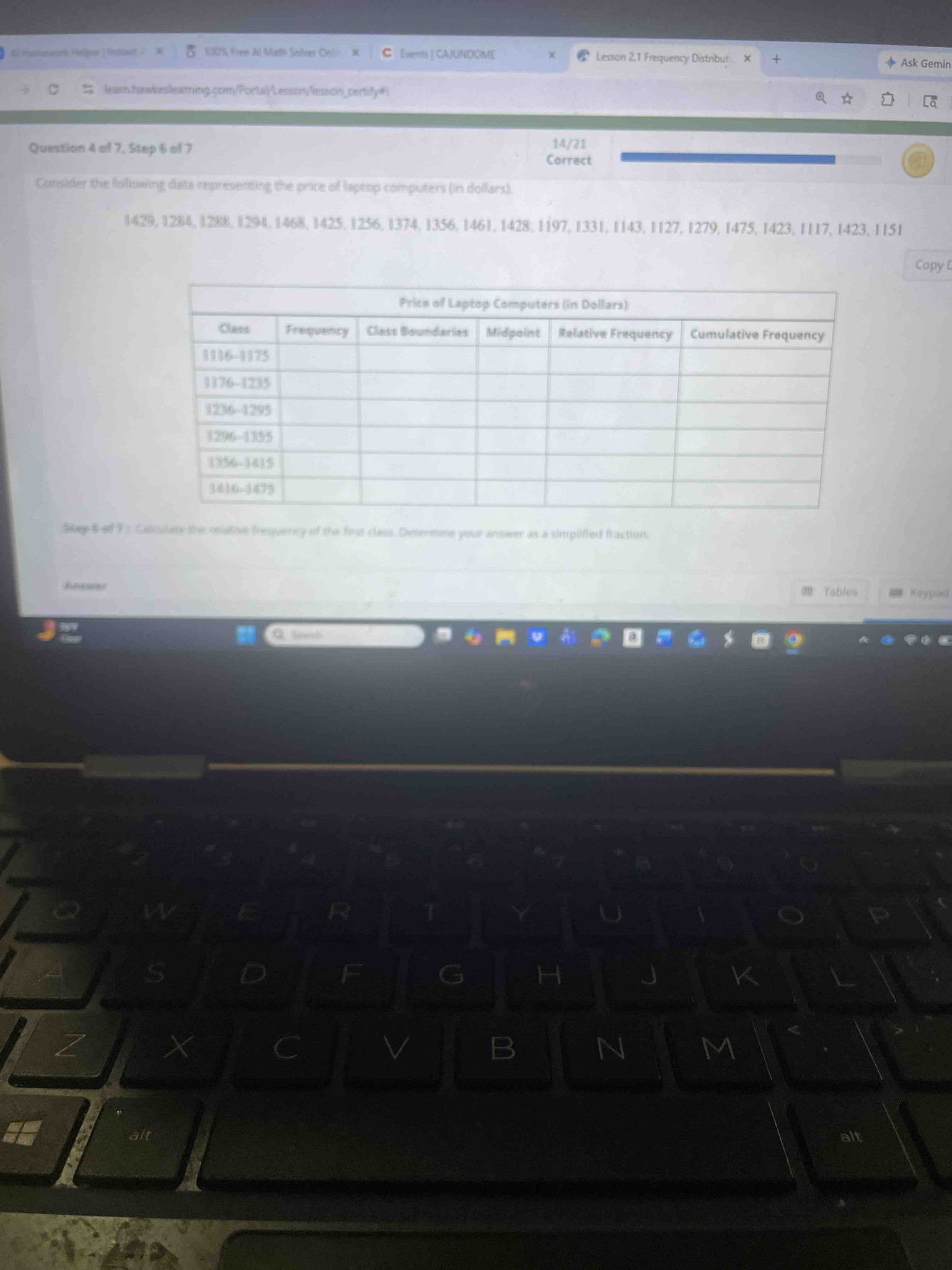
Consider the following data representing the price of laptop computers (in dollars): 1429, 1284, 1288, 1294, 1468, 1425, 1256, 1374, 1356, 1461, 1428, 1197, 1331, 1143, 1127, 1279, 1475, 1423, 1117, 1423, 1151. Step 6 of 7: Calculate the relative frequency of the first class. Determine your answer as a simplified fraction.
Answer
First, we need to count the total number of data points ($n$) in the set. There are 21 values provided. Next, we find the frequency of the first class, which has the interval 1116-1175. Looking through the data, the values that fall into this range are: 1143, 1127, 1117, and 1151. There are exactly 4 such values, so the frequency for the first class is 4. Relative frequency is calculated by dividing the frequency of a specific class by the total number of data points. In this case, the relative frequency is 4/21. This fraction cannot be further simplified because 4 and 21 have no common factors other than 1. Therefore, the relative frequency of the first class is 4/21.