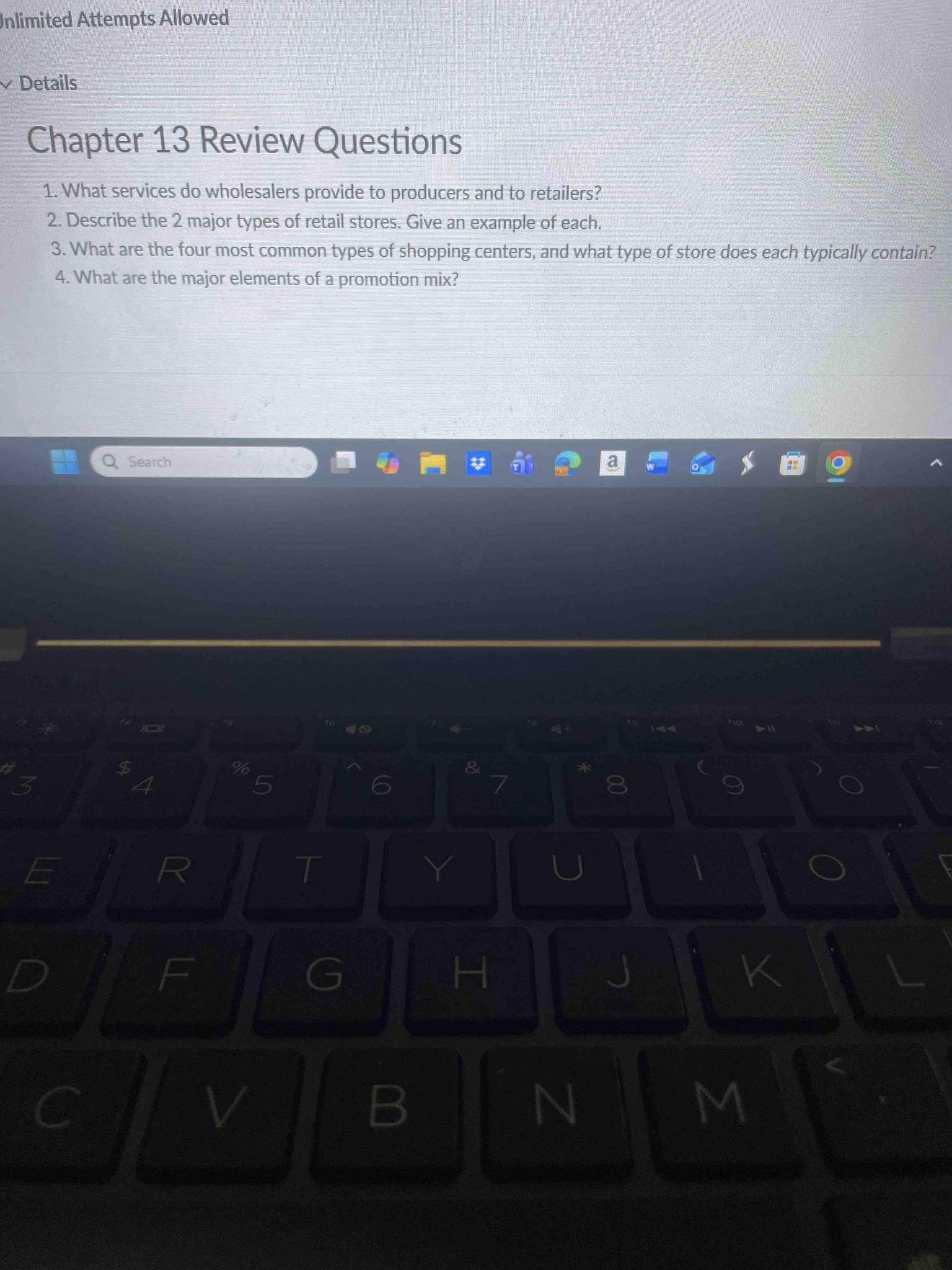
Chapter 13 Review Questions: 1. What services do wholesalers provide to producers and to retailers? 2. Describe the 2 major types of retail stores. Give an example of each. 3. What are the four most common types of shopping centers, and what type of store does each typically contain? 4. What are the major elements of a promotion mix?
Answer
1. Wholesalers provide several essential services to both producers and retailers. For producers, they act as a sales force, reduce inventory carrying costs by buying in bulk, provide market information, and offer financial assistance through prompt payments. For retailers, wholesalers perform the 'breaking bulk' function by selling in smaller quantities, provide faster delivery, offer credit terms, and provide expert advice on product selection and merchandising. 2. The two major types of retail stores are General-Merchandise Retailers and Specialty Retailers. General-merchandise retailers offer a wide variety of product lines. An example is a Department Store like Macy's or a Supermarket like Kroger. Specialty retailers carry a narrow product mix with deep product lines. An example is a jewelry store like Zales or an electronics store like Best Buy. 3. The four most common types of shopping centers are: (a) Neighborhood Shopping Centers, which contain small convenience and specialty stores (e.g., a dry cleaner or small grocery); (b) Community Shopping Centers, which typically include a department store or a discount store along with specialty shops; (c) Regional Shopping Centers, which are large enclosed malls featuring at least two major department stores and many specialty stores; and (d) Lifestyle Centers, which are open-air environments with high-end specialty stores and dining. 4. The four major elements of a promotion mix are: (a) Advertising, which is paid non-personal communication; (b) Personal Selling, which involves direct oral communication to persuade purchasers; (c) Sales Promotion, which includes short-term incentives like coupons or contests; and (d) Public Relations (or Publicity), which focuses on building a favorable image for the company through media coverage and community involvement.