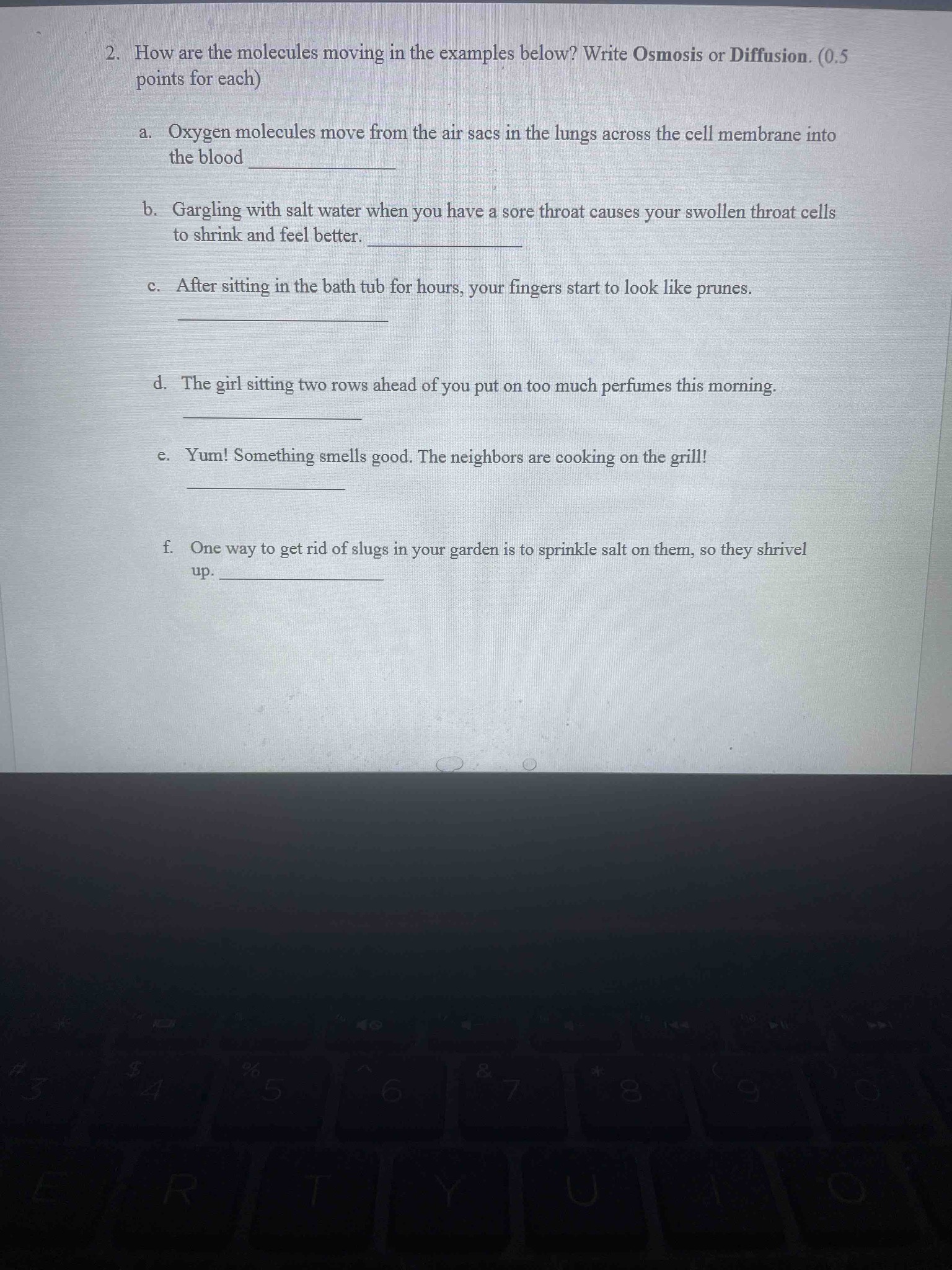
How are the molecules moving in the examples below? Write Osmosis or Diffusion. a. Oxygen molecules move from the air sacs in the lungs across the cell membrane into the blood. b. Gargling with salt water when you have a sore throat causes your swollen throat cells to shrink and feel better. c. After sitting in the bath tub for hours, your fingers start to look like prunes. d. The girl sitting two rows ahead of you put on too much perfumes this morning. e. Yum! Something smells good. The neighbors are cooking on the grill! f. One way to get rid of slugs in your garden is to sprinkle salt on them, so they shrivel up.
Answer
To determine the correct answer, one must distinguish between Diffusion and Osmosis. Diffusion is the movement of solute particles (like gas or scent molecules) from an area of high concentration to an area of low concentration. Osmosis is a specific type of diffusion referring specifically to the movement of water molecules across a semi-permeable membrane. a. Diffusion: Oxygen is a gas molecule moving from high concentration in the lungs to lower concentration in the blood. b. Osmosis: Salt water creates a high solute environment outside the cells, causing water to move out of the swollen throat cells to balance the concentration, making them shrink. c. Osmosis: When you soak in water, water moves into or out of your skin cells across the semi-permeable cell membrane to balance solute concentrations, causing pruning. d. Diffusion: Scent molecules from the perfume spread through the air from an area of high concentration (the girl) to an area of low concentration (where you are sitting). e. Diffusion: Scent particles from the cooking food travel through the air to reach your nose. f. Osmosis: Salt on the slug's skin creates a hypertonic environment, drawing water out of the slug's body across its semi-permeable skin, causing it to shrivel.