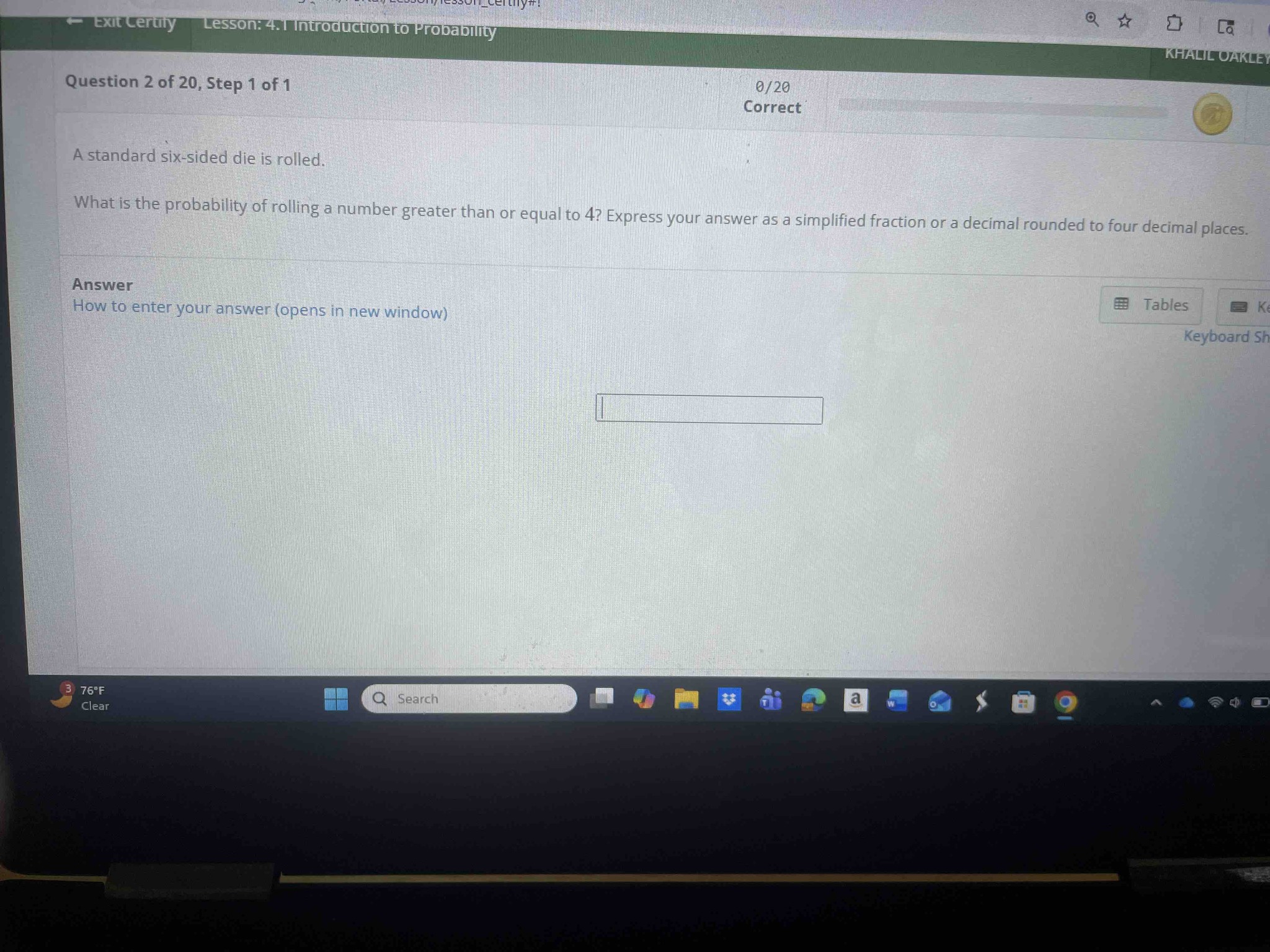
A standard six-sided die is rolled. What is the probability of rolling a number greater than or equal to 4? Express your answer as a simplified fraction or a decimal rounded to four decimal places.
Answer
1. Identify the sample space: A standard six-sided die has the outcomes {1, 2, 3, 4, 5, 6}. So, the total number of possible outcomes is 6. 2. Identify the favorable outcomes: The question asks for a number greater than or equal to 4. These outcomes are {4, 5, 6}. 3. Count the number of favorable outcomes: There are 3 favorable outcomes. 4. Calculate the probability: Probability (P) is the number of favorable outcomes divided by the total number of possible outcomes. P = 3/6. 5. Simplify the fraction: 3/6 simplifies to 1/2. 6. Convert to decimal (optional): 1/2 is equal to 0.5. The final answer as a simplified fraction is 1/2 or as a decimal 0.5000.