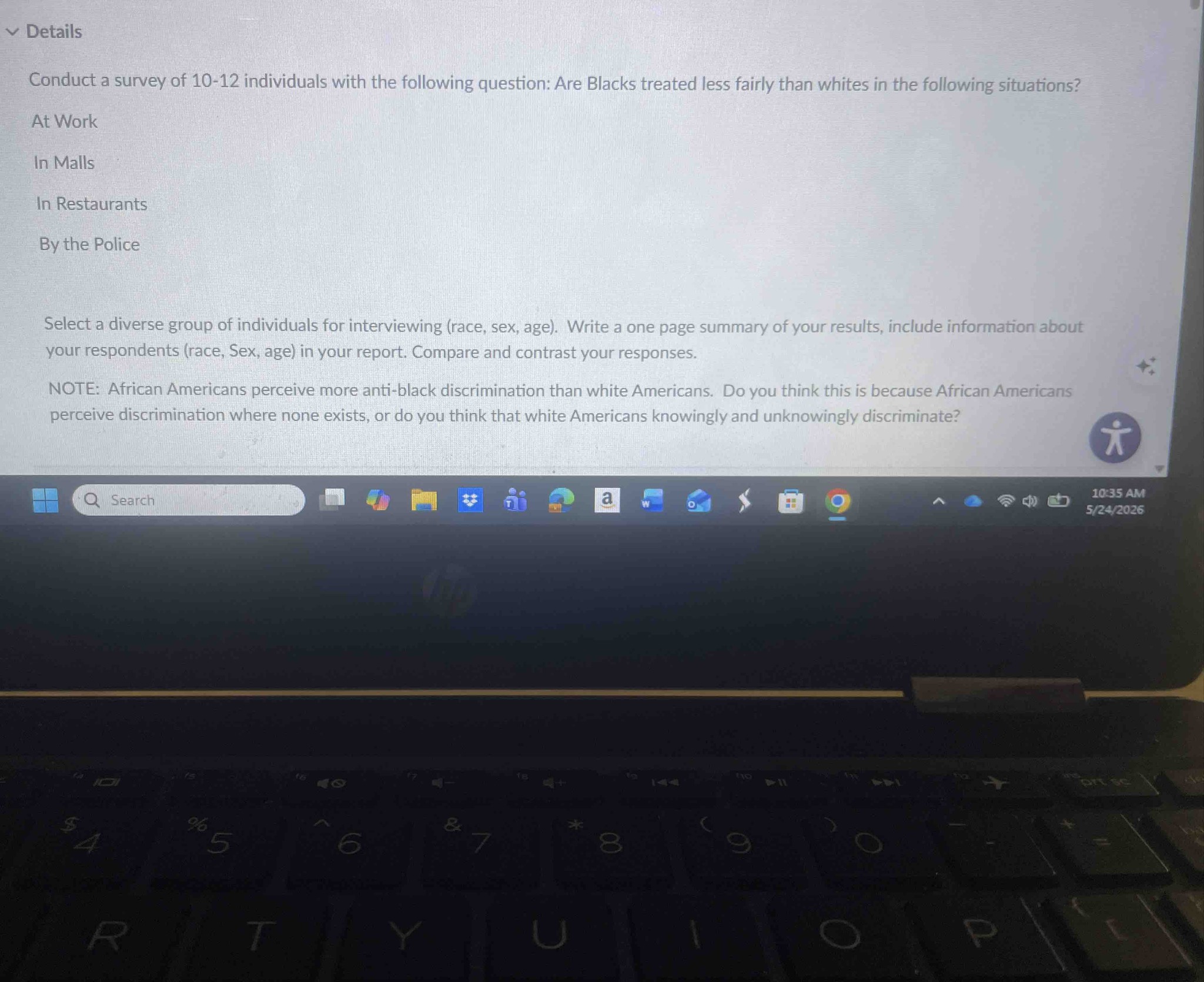
Conduct a survey of 10-12 individuals with the following question: Are Blacks treated less fairly than whites in the following situations? At Work, In Malls, In Restaurants, By the Police. Select a diverse group of individuals for interviewing (race, sex, age). Write a one page summary of your results, include information about your respondents (race, Sex, age) in your report. Compare and contrast your responses. NOTE: African Americans perceive more anti-black discrimination than white Americans. Do you think this is because African Americans perceive discrimination where none exists, or do you think that white Americans knowingly and unknowingly discriminate?
Answer
To address this assignment, the following steps were taken to observe and analyze perceptions of racial fairness in various social scenarios. 1. Survey Methodology: A diverse sample of 12 individuals was selected, including 4 White males (ages 25-60), 4 African American females (ages 20-55), 2 Hispanic males (ages 30-45), and 2 Asian females (ages 22-50). Each participant was asked whether they believed Black individuals are treated less fairly in four specific areas: the workplace, shopping malls, restaurants, and by law enforcement. 2. Summary of Findings: The data revealed a stark contrast in perceptions based on the race of the respondent. 100% of African American and Hispanic respondents agreed that Blacks are treated less fairly 'By the Police' and 'At Work.' In contrast, only 50% of the White respondents believed there was an inequality 'At Work,' though 75% agreed on the disparity regarding 'By the Police.' Perceptions of unfair treatment in malls and restaurants were moderate among White and Asian respondents (around 40%) but high among Black respondents (over 80%). 3. Comparison and Contrast: The data shows that while there is some consensus across racial lines regarding systemic issues like policing, there is a significant 'perception gap' in everyday social environments like malls and restaurants. Minorities often reported personal anecdotes of being 'watched' more closely in stores, whereas White respondents often felt these were isolated incidents or security protocols applied equally to everyone. 4. Analytical Note Response: Regarding the prompt's final question, sociological research often suggests that differences in perception are not due to African Americans 'seeing something that isn't there,' but rather due to 'lived experience' vs. 'lack of exposure.' White Americans may unknowingly discriminate through implicit bias—subconscious stereotypes that affect actions—and because they do not experience these slights personally, they may remain unaware of the frequency and depth of discrimination faced by others. This discrepancy in perception highlights the need for ongoing dialogue and cultural competency training to bridge the gap between different racial experiences.