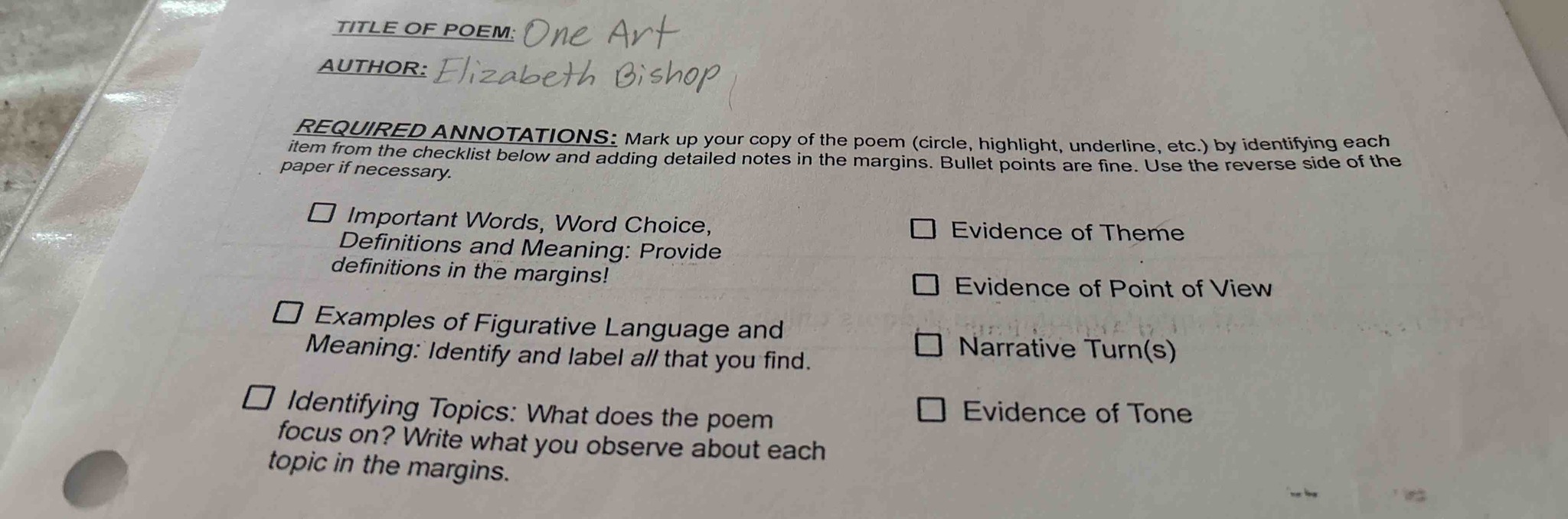
The provided image shows a poetry analysis worksheet for the poem 'One Art' by Elizabeth Bishop. The task is to complete the 'REQUIRED ANNOTATIONS' by marking up a copy of the poem and identifying specific elements from a provided checklist: Important Words, Word Choice, Definitions and Meaning; Examples of Figurative Language and Meaning; Identifying Topics; Evidence of Theme; Evidence of Point of View; Narrative Turn(s); and Evidence of Tone.
Answer
To fulfill the requirements of this poetry analysis for Elizabeth Bishop's 'One Art,' one should follow these steps: 1. **Word Choice & Definitions**: Note the technical term 'villanelle' for the poem's form. Pay attention to the word 'master' which is repeated throughout, suggesting control over something inherently uncontrollable - loss. 2. **Figurative Language**: Identify the metaphor in the title 'One Art,' which compares the experience of losing things to a skill or 'art' that can be learned. Look for personification where 'things' seem 'filled with the intent to be lost.' 3. **Identifying Topics**: The poem focuses on various levels of loss, starting from trivial items (door keys) to greater losses (places, names, and finally, a loved person). 4. **Evidence of Theme**: The central theme is the inevitability of loss and the human attempt to cope with it through irony and detachment. The refrain 'The art of losing isn't hard to master' serves as structural evidence of this theme. 5. **Point of View**: The poem is written in the first person ('I'), making the exploration of loss deeply personal yet oddly clinical. 6. **Narrative Turn**: The 'turn' or 'volta' occurs in the final stanza where the speaker shifts from discussing general losses to a specific, painful loss of a 'you.' The parentheses '(Write it!)' indicate a breakdown in the speaker's stoic facade. 7. **Evidence of Tone**: Initially, the tone is nonchalant and instructional. However, by the end, the tone becomes strained and vulnerable as the speaker struggles to maintain the 'art' of mastering loss.