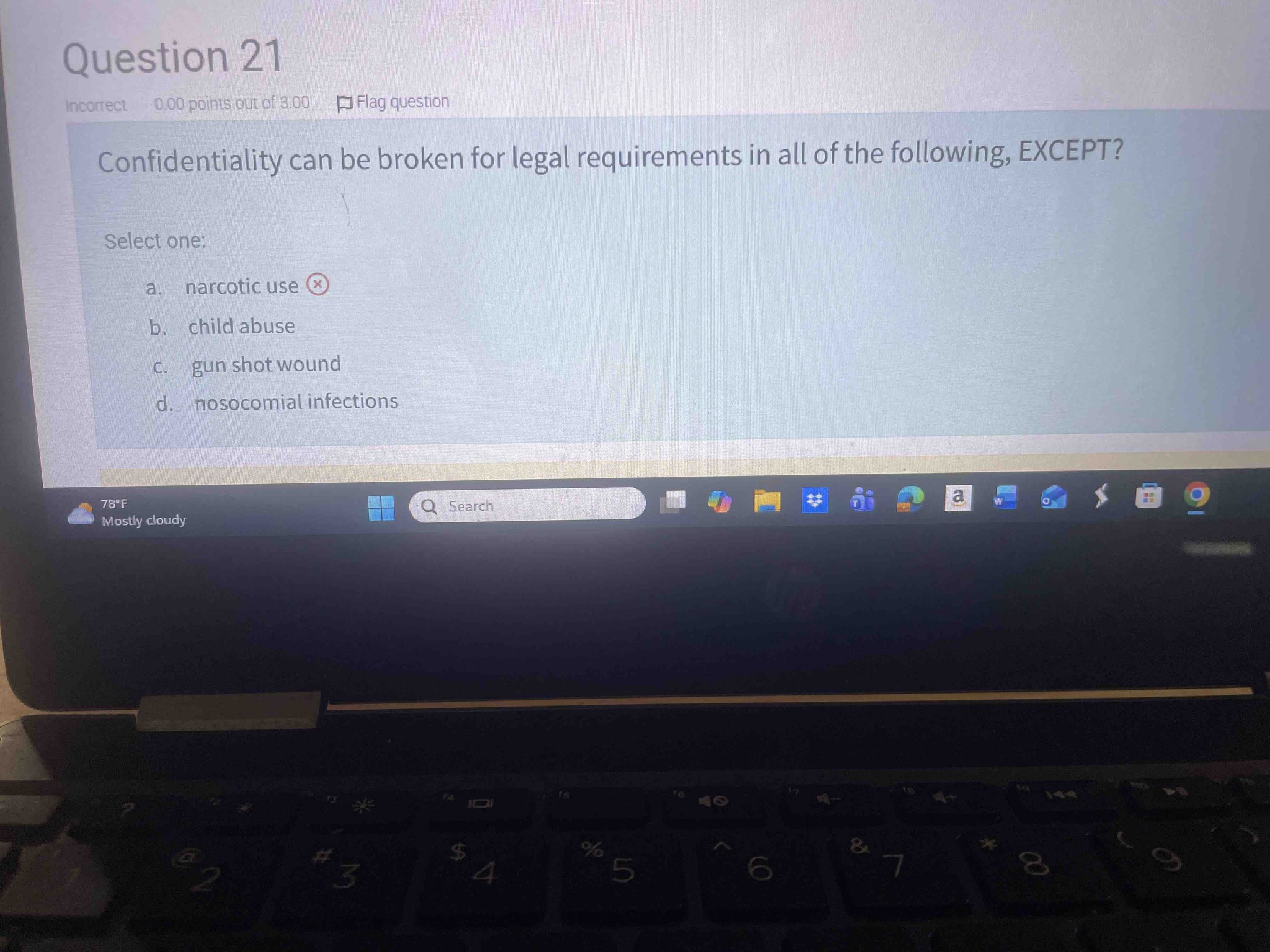
Confidentiality can be broken for legal requirements in all of the following, EXCEPT? Select one: a. narcotic use, b. child abuse, c. gun shot wound, d. nosocomial infections
Answer
The correct answer is d. nosocomial infections. In the medical and healthcare field, patient confidentiality is a fundamental principle, but it is not absolute. There are mandatory reporting requirements where the law requires healthcare providers to disclose patient information to authorities. Mandatory reporting usually includes: 1. Child or elder abuse/neglect: To protect vulnerable populations. 2. Certain criminal acts: Such as gun shot wounds or stabbings, to assist in law enforcement investigations. 3. Communicable diseases or substance misuse: Public health laws often require reporting certain communicable diseases or narcotic use to monitor public health trends and safety. While nosocomial infections (hospital-acquired infections) are critical for internal quality control and hospital safety reporting, they typically do not involve a legal requirement to breach an individual patient's confidentiality to outside law enforcement or social service agencies in the same mandatory manner as the other options. Therefore, while data about infection rates is tracked, the individual patient's confidentiality is generally maintained within the healthcare system's quality assurance framework rather than being a standard legal exception for breaking confidentiality to external legal authorities.