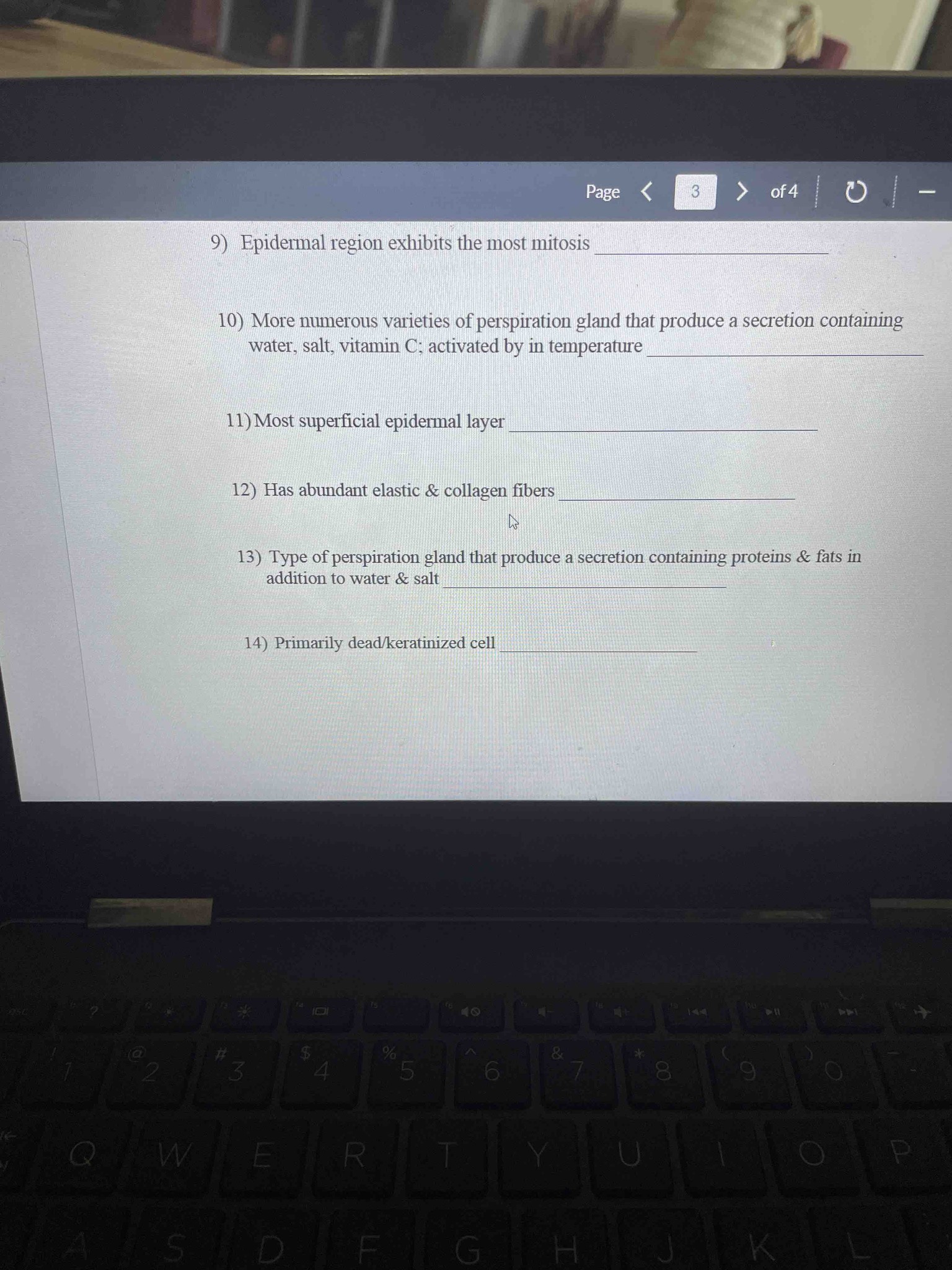
9) Epidermal region exhibits the most mitosis 10) More numerous varieties of perspiration gland that produce a secretion containing water, salt, vitamin C; activated by in temperature 11) Most superficial epidermal layer 12) Has abundant elastic & collagen fibers 13) Type of perspiration gland that produce a secretion containing proteins & fats in addition to water & salt 14) Primarily dead/keratinized cell
Answer
9) Stratum Basale (Stratum Germinativum): This is the deepest layer of the epidermis, where cells undergo rapid cell division (mitosis) to constantly renew the skin's surface. 10) Eccrine (merocrine) sweat glands: These are the more common type of sweat glands, found all over the body. They secrete a watery substance to regulate body temperature through evaporative cooling. 11) Stratum Corneum: This is the outermost layer of the epidermis, consisting of flattened, dead keratinocytes that provide a protective barrier. 12) Dermis: Unlike the cellular epidermis, the dermis is composed primarily of connective tissue. It contains a dense network of collagen fibers for strength and elastic fibers for flexibility. 13) Apocrine sweat glands: Located mostly in axillary and anogenital areas, these glands secrete a thicker fluid containing proteins and lipids, often associated with body odor when broken down by bacteria. 14) Stratum Corneum: Cells in this topmost layer are fully keratinized and dead, forming a tough, water-resistant outer shield for the body.