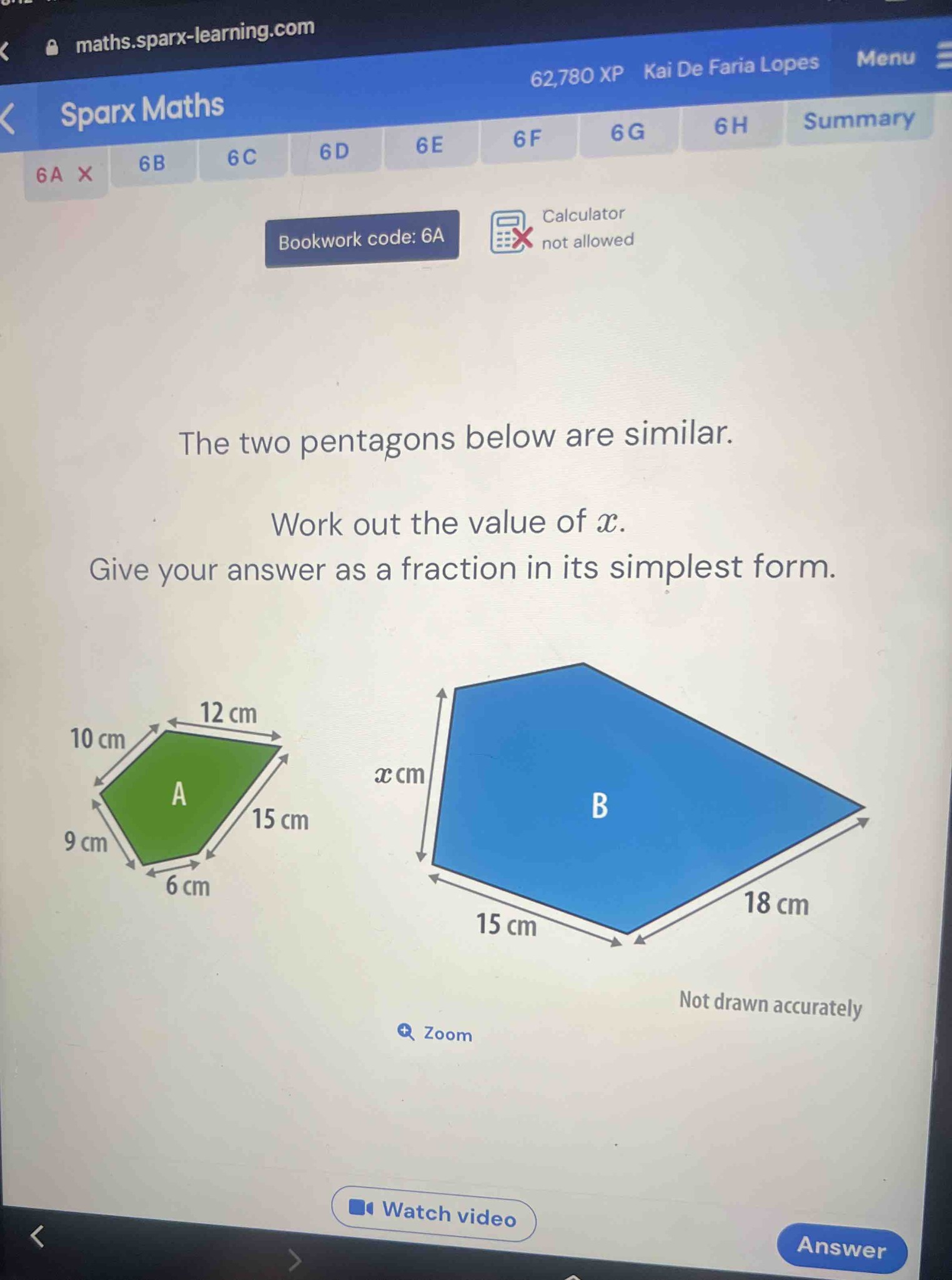
The two pentagons below are similar. Work out the value of x. Give your answer as a fraction in its simplest form.
Answer
1. Identify corresponding sides: To find the scale factor between similar shapes, we must find a pair of sides that are both known. Comparing pentagon A and pentagon B, the bottom-left side of pentagon A is 6 cm, and the corresponding bottom-left side of pentagon B is 15 cm. 2. Calculate the scale factor: Scale factor = side length in B / corresponding side length in A = 15 / 6. Simplifying this fraction by dividing both numbers by 3 gives 5 / 2. 3. Set up the equation for x: The side labeled 'x' in pentagon B corresponds to the side labeled '10 cm' in pentagon A. Therefore, x = 10 * (Scale Factor). 4. Solve for x: x = 10 * (15 / 6) = 150 / 6. Alternatively, using the simplified scale factor: x = 10 * (5 / 2) = 50 / 2 = 25. Wait, let's re-examine the corresponding sides. Looking at the orientation, the side of length 9 cm in A corresponds to the side labeled x in B. Let's verify with another pair: 15 cm in A corresponds to 18 cm in B? No, the labels suggest a rotation or reflection. Looking closely at the geometry: the side of length 6 cm in A corresponds to 15 cm in B (Scale Factor = 15/6 = 2.5). The side of length 9 cm in A corresponds to side x in B. Therefore, x = 9 * 2.5 = 22.5. Let's re-verify matching: 6 matches 15 (ratio 2.5). 15 matches 18? (ratio 1.2). This suggests the shapes might be reflected. If 12 in A corresponds to 15 in B, SF = 1.25. Then 15 in A corresponds to 18 in B? 15 * 1.25 = 18.75 (No). Let's look at the labels again. The side 6cm in A is clearly the shortest base. In B, 15cm is the base. SF = 15/6 = 2.5. The side 9cm in A is adjacent to the 6cm side. Its corresponding side in B is x. Thus, x = 9 * (15/6) = 9 * 2.5 = 22.5. As a fraction: x = 9 * 5/2 = 45/2.