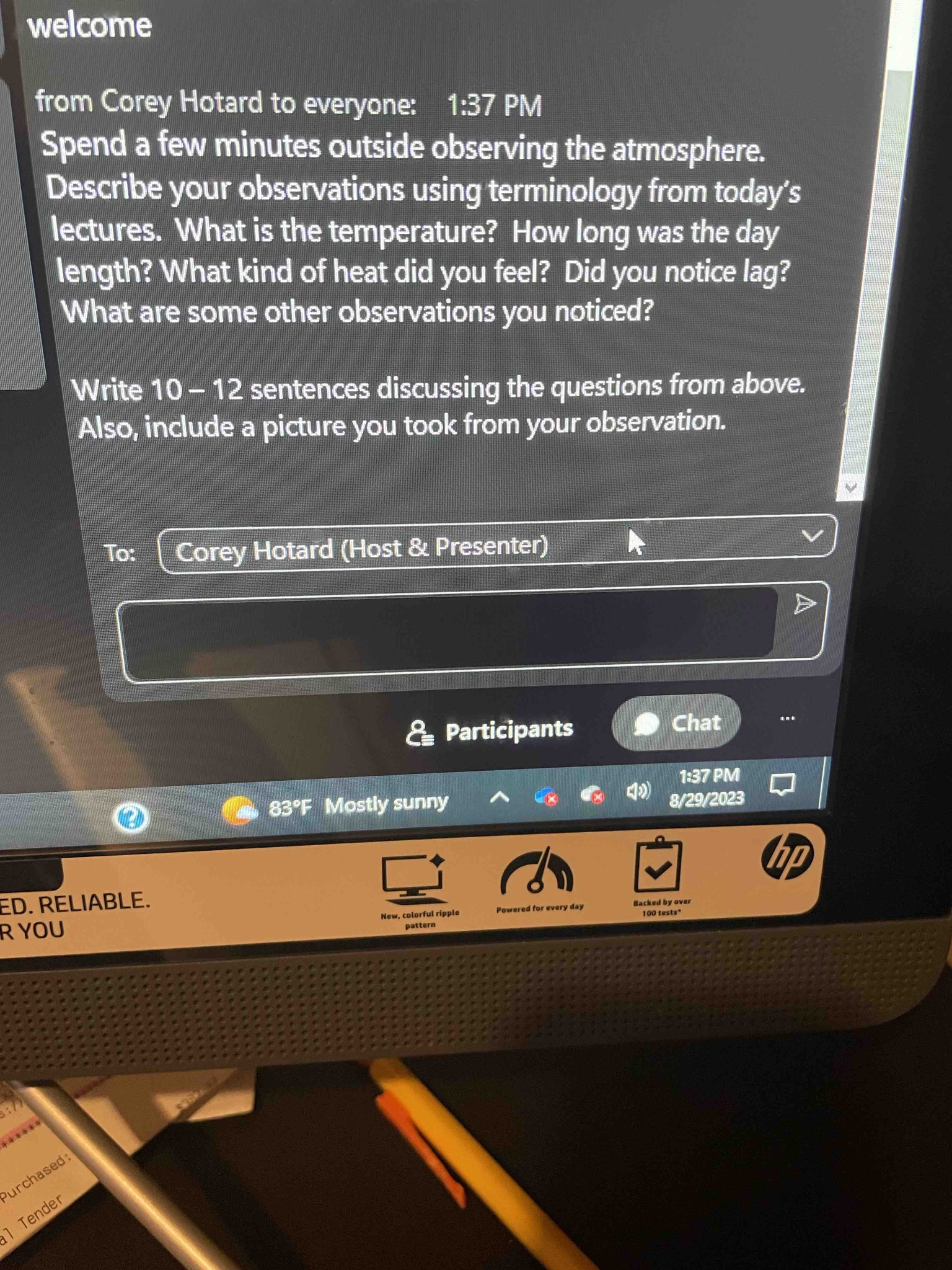
Spend a few minutes outside observing the atmosphere. Describe your observations using terminology from today's lectures. What is the temperature? How long was the day length? What kind of heat did you feel? Did you notice lag? What are some other observations you noticed? Write 10 - 12 sentences discussing the questions from above. Also, include a picture you took from your observation.
Answer
To fulfill this assignment based on the provided image, you can synthesize the observable data from the computer screen (dated 8/29/2023 at 1:37 PM) with atmospheric science concepts. According to the taskbar, the current temperature is 83°F under mostly sunny skies. In August, the day length is relatively long, though it is beginning to decrease as we approach the autumnal equinox. When standing outside, you would likely feel 'sensible heat,' which is the heat transfer we can sense and measure with a thermometer through conduction and convection. Regarding seasonal lag, even though the summer solstice (peak solar radiation) occurred in June, temperatures remain very high in late August because the earth's surface continues to absorb and store more energy than it radiates back for several months. Other observations might include high humidity, which represents latent heat stored in water vapor. The sky appears mostly clear with high insolation, meaning direct solar radiation is hitting the surface with little scattering. Furthermore, you might observe convective clouds forming due to the afternoon heating of the surface. This thermal energy transfer is essential to understanding the local weather patterns. By combining the 83-degree observation with the concepts of radiation, conduction, and seasonal lag, you can describe the current atmospheric state in detail. Don't forget to attach a original photo of the sky to complete the submission.