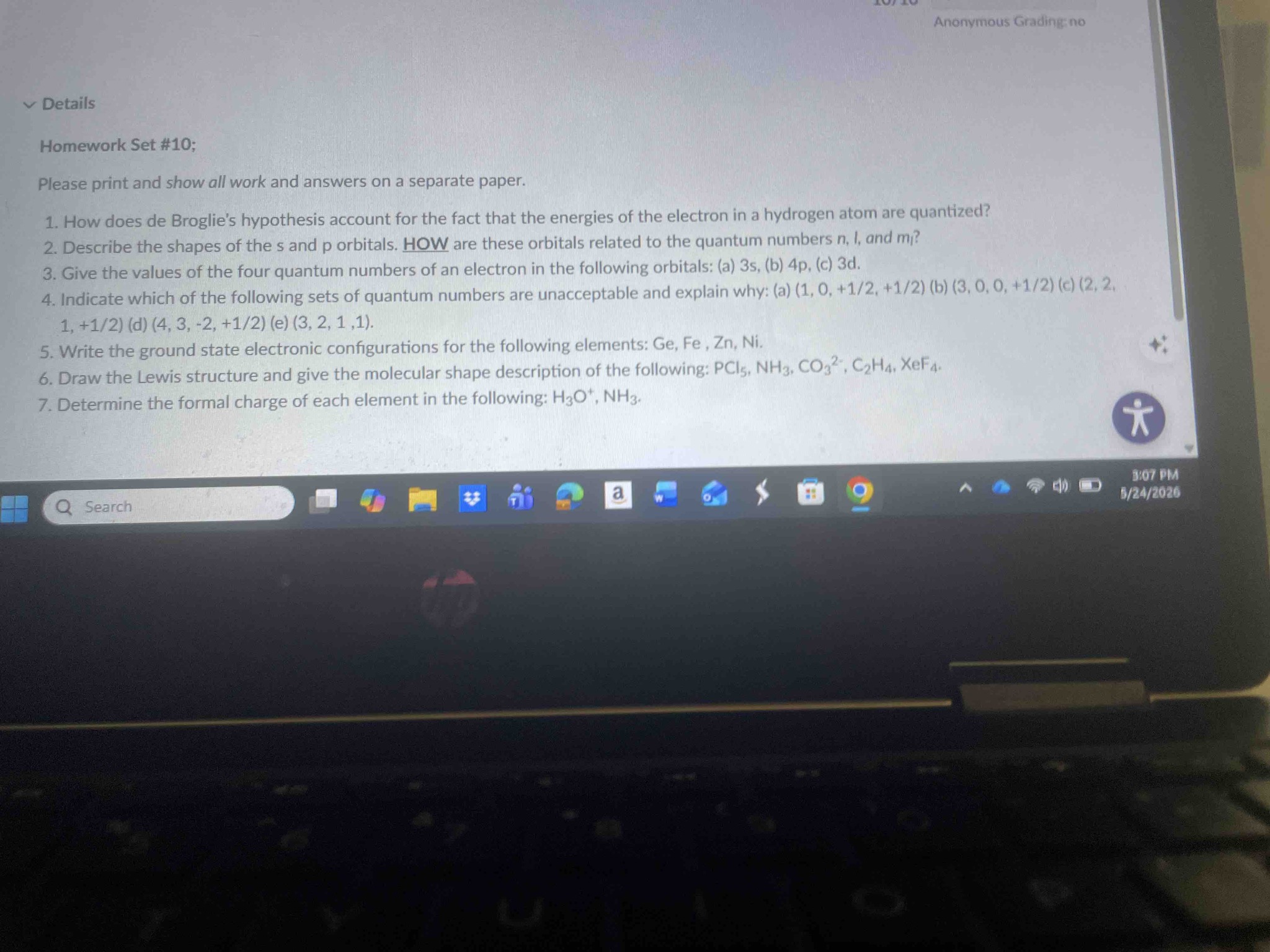
Homework Set #10: 1. How does de Broglie's hypothesis account for the fact that the energies of the electron in a hydrogen atom are quantized? 2. Describe the shapes of the s and p orbitals. HOW are these orbitals related to the quantum numbers n, l, and ml? 3. Give the values of the four quantum numbers of an electron in the following orbitals: (a) 3s, (b) 4p, (c) 3d. 4. Indicate which of the following sets of quantum numbers are unacceptable and explain why: (a) (1, 0, +1/2, +1/2) (b) (3, 0, 0, +1/2) (c) (2, 2, 1, +1/2) (d) (4, 3, -2, +1/2) (e) (3, 2, 1, 1). 5. Write the ground state electronic configurations for the following elements: Ge, Fe, Zn, Ni. 6. Draw the Lewis structure and give the molecular shape description of the following: PCl5, NH3, CO3^2-, C2H4, XeF4. 7. Determine the formal charge of each element in the following: H3O+, NH3.
Answer
1. De Broglie's hypothesis suggests that particles like electrons exhibit wave-like behavior. In a hydrogen atom, the electron wave must form a standing wave around the nucleus. This condition is only met if the circumference of the orbit (2πr) is an integer multiple of the electron's wavelength (nλ). Because λ is related to momentum according to de Broglie (λ = h/p), only specific radii and thus specific, discrete energy levels (quantized states) are allowed. 2. The 's' orbital is spherical in shape. The 'p' orbital is shaped like a dumbbell (two lobes on either side of the nucleus). The quantum number 'n' (principal) determines the size and energy level; 'l' (angular momentum) determines the shape (l=0 for s, l=1 for p); and 'ml' (magnetic) determines the spatial orientation (ml=0 for s; ml = -1, 0, +1 for p along x, y, and z axes). 3. (a) 3s: n=3, l=0, ml=0, ms=+1/2 or -1/2. (b) 4p: n=4, l=1, ml=-1, 0, or +1, ms=+1/2 or -1/2. (c) 3d: n=3, l=2, ml=-2, -1, 0, +1, or +2, ms=+1/2 or -1/2. 4. (a) Unacceptable; l must be less than n (l=0 is okay, but the third value provided is ms, and a 4th value is missing or incorrect, if following the format (n, l, ml, ms), then ml here is +1/2 which is impossible as ml must be an integer). (b) Acceptable. (c) Unacceptable; l must be strictly less than n (l cannot be 2 if n is 2). (d) Acceptable. (e) Unacceptable; the spin quantum number ms must be +1/2 or -1/2 (it cannot be 1). 5. Ge (Z=32): [Ar] 4s2 3d10 4p2. Fe (Z=26): [Ar] 4s2 3d6. Zn (Z=30): [Ar] 4s2 3d10. Ni (Z=28): [Ar] 4s2 3d8. 6. PCl5: Trigonal bipyramidal. Phosphorus central, five Cl atoms bonded. NH3: Trigonal pyramidal. N central with one lone pair and three H atoms. CO3^2-: Trigonal planar. C central with one double bond and two single bonds to Cl (resonance structure). C2H4: Each carbon is Trigonal planar. H2C=CH2 structure. XeF4: Square planar. Xe central with 2 lone pairs and 4 F atoms. 7. Formal Charge = (Valence e-) - (Non-bonding e-) - (Bonding e- / 2). For H3O+: H = 1 - 0 - (2/2) = 0; O = 6 - 2 - (6/2) = +1. For NH3: N = 5 - 2 - (6/2) = 0; H = 1 - 0 - (2/2) = 0.