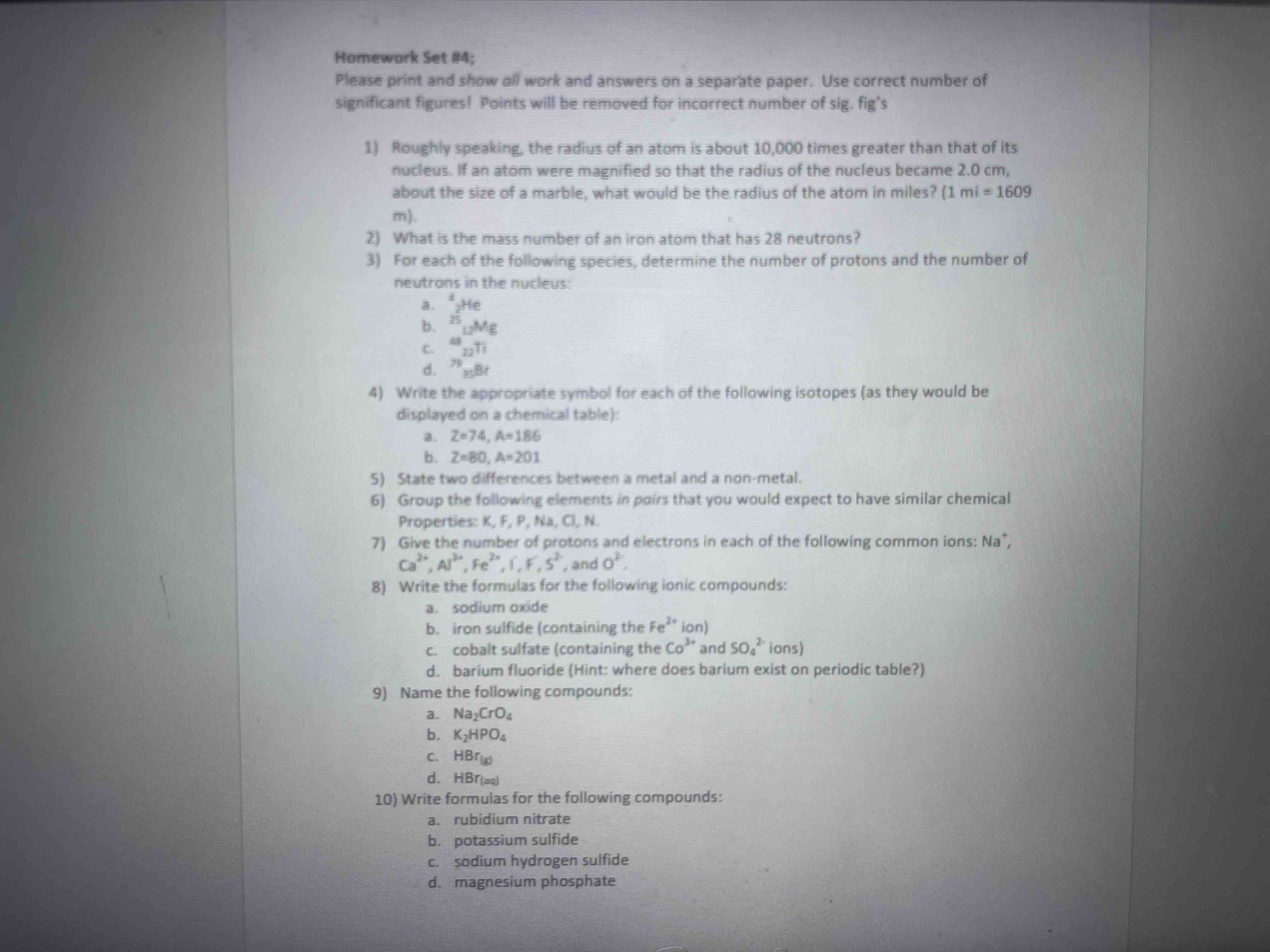
The image contains Homework Set #4 with 10 problems covering topics such as atomic structure, isotopes, periodic properties, and chemical nomenclature. Key questions include calculating atomic radius scales, identifying proton/neutron counts in isotopes, naming ionic compounds, and writing chemical formulas.
Answer
1) Ratio = 10,000. Nucleus radius = 2.0 cm. Atom radius = 2.0 cm * 10,000 = 20,000 cm. Convert to miles: 20,000 cm * (1 m / 100 cm) * (1 mi / 1609 m) = 0.12 miles. 2) Iron (Fe) has atomic number 26. Mass number = protons + neutrons = 26 + 28 = 54. 3) Protons (Z) and Neutrons (N = A - Z): a. He (Z=2, N=2); b. Mg (Z=12, N=13); c. Ti (Z=22, N=26); d. Br (Z=35, N=44). 4) a. Z=74 is Tungsten (W), Symbol: 186W. b. Z=80 is Mercury (Hg), Symbol: 201Hg. 5) Metals are generally conductive and malleable, while non-metals are insulating and brittle. 6) Similar chemical properties occur in groups: (K, Na) Alkali metals; (F, Cl) Halogens; (P, N) Pnictogens. 7) Na+: 11p, 10e; Ca2+: 20p, 18e; Al3+: 13p, 10e; Fe2+: 26p, 24e; I-: 53p, 54e; F-: 9p, 10e; S2-: 16p, 18e; O2-: 8p, 10e. 8) a. Na2O; b. FeS; c. Co2(SO4)3; d. BaF2. 9) a. Sodium chromate; b. Potassium hydrogen phosphate; c. Hydrogen bromide gas; d. Hydrobromic acid. 10) a. RbNO3; b. K2S; c. NaHS; d. Mg3(PO4)2.