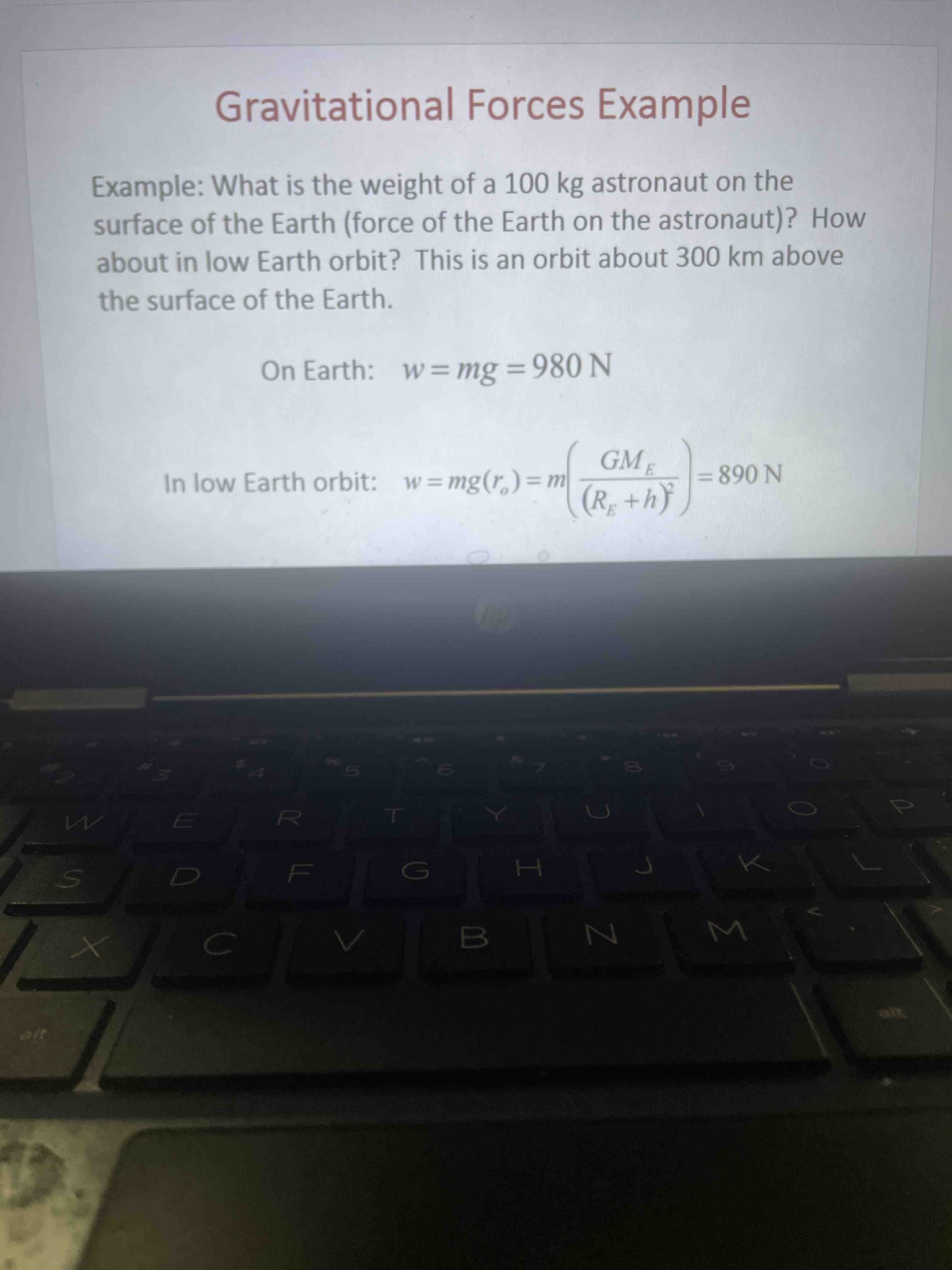
What is the weight of a 100 kg astronaut on the surface of the Earth (force of the Earth on the astronaut)? How about in low Earth orbit? This is an orbit about 300 km above the surface of the Earth.
Answer
To find the weight on the surface of the Earth, we use the formula w = mg, where m is the mass (100 kg) and g is the acceleration due to gravity on the surface (approximately 9.8 m/s^2). Thus, w = 100 kg * 9.8 m/s^2 = 980 N. To find the weight in low Earth orbit at an altitude (h) of 300 km, we must account for the increased distance from Earth's center. The formula for weight becomes w = m * [G * M_E / (R_E + h)^2], where G is the gravitational constant, M_E is the mass of the Earth, and R_E is the radius of the Earth. Given that R_E is approximately 6,371 km, the total distance (r) from the center is 6,371 km + 300 km = 6,671 km. Plugging these values into the universal gravitation formula yields a weight of approximately 890 N. This shows that even in low Earth orbit, gravity is still quite strong, being about 90% of its surface value.