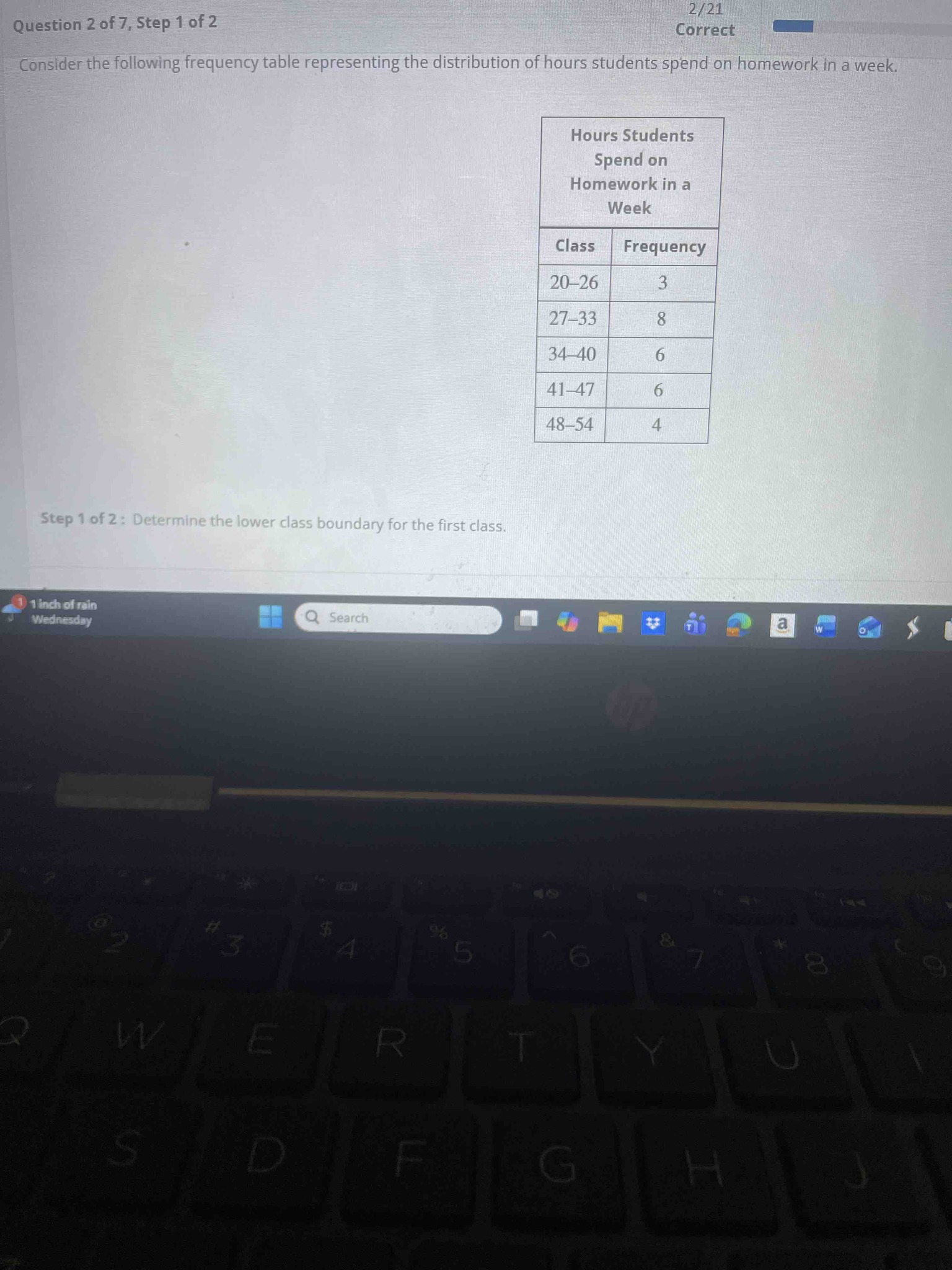
Consider the following frequency table representing the distribution of hours students spend on homework in a week. Determine the lower class boundary for the first class.
Answer
To determine the lower class boundary for the first class, we first identify the first class interval, which is 20-26. In this interval, the lower class limit is 20 and the upper class limit is 26. Class boundaries are the values used to separate classes so that there are no gaps in the frequency distribution. For data involving whole numbers, the boundary is found by subtracting 0.5 from the lower limit and adding 0.5 to the upper limit. This is calculated as the midpoint between the lower limit of a class and the upper limit of the preceding class. Since the gap between the upper limit of one class (e.g., 26) and the lower limit of the next class (e.g., 27) is 1 unit, we split this gap in half (0.5). Therefore, the lower class boundary for the first class (20-26) is calculated as: Lower Limit - 0.5 = 20 - 0.5 = 19.5.