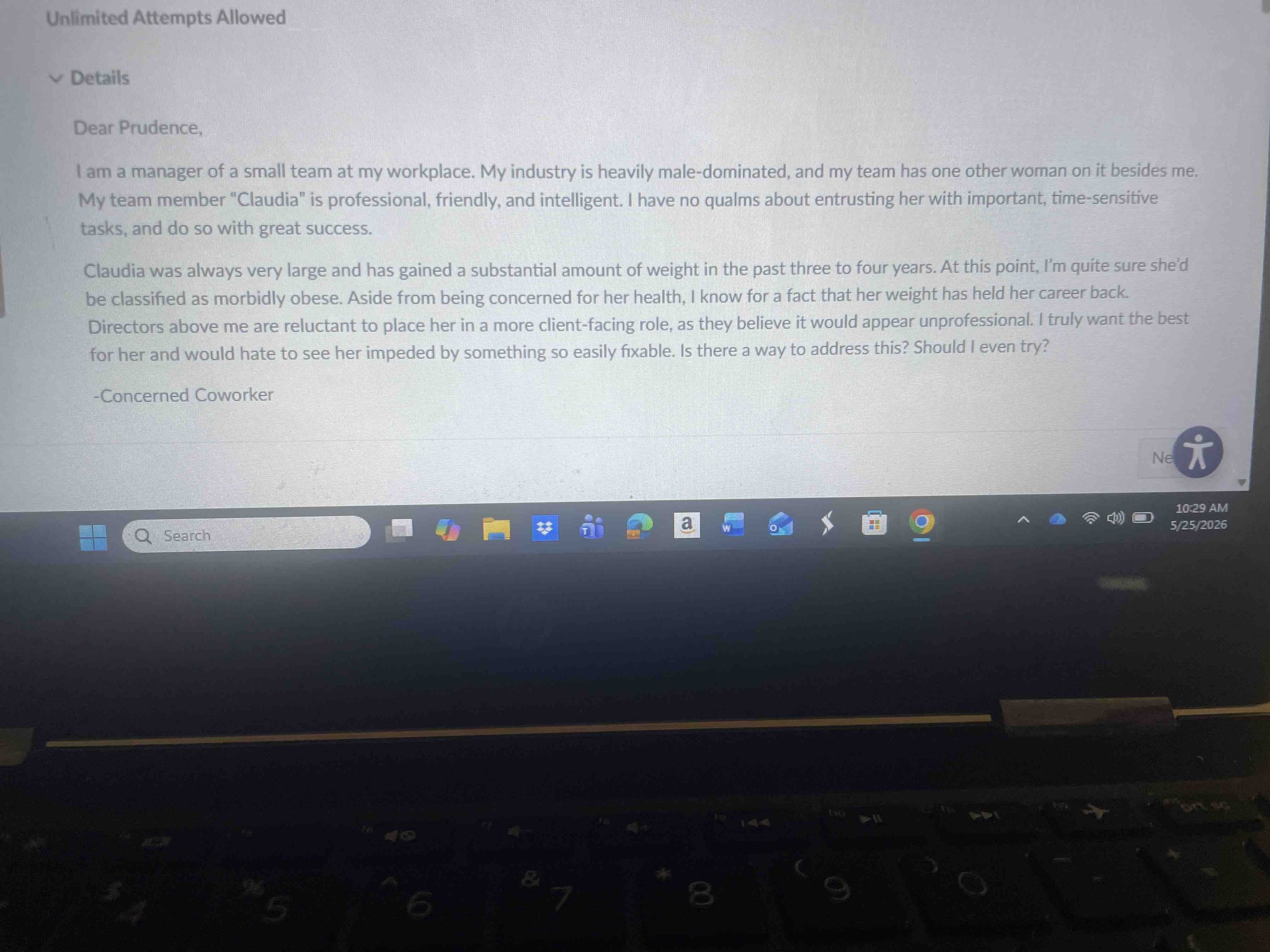
Dear Prudence, I am a manager of a small team at my workplace. My industry is heavily male-dominated, and my team has one other woman on it besides me. My team member 'Claudia' is professional, friendly, and intelligent. I have no qualms about entrusting her with important, time-sensitive tasks, and do so with great success. Claudia was always very large and has gained a substantial amount of weight in the past three to four years. At this point, I'm quite sure she'd be classified as morbidly obese. Aside from being concerned for her health, I know for a fact that her weight has held her career back. Directors above me are reluctant to place her in a more client-facing role, as they believe it would appear unprofessional. I truly want the best for her and would hate to see her impeded by something so easily fixable. Is there a way to address this? Should I even try? -Concerned Coworker
Answer
The best solution to this workplace dilemma is to avoid having a conversation with Claudia about her weight and instead focus on advocating for her based on her performance. First, as a manager, commenting on an employee's physical appearance or health status is highly unprofessional and could lead to legal liabilities or HR complaints, as weight can be linked to protected medical conditions. Second, the writer mentions that Claudia is professional, friendly, and intelligent, and performs her tasks with great success. Therefore, the manager's role is to push back against the directors' biased perception that her weight is 'unprofessional.' The manager should present concrete evidence of Claudia's successes and argue that her skills make her the best candidate for client-facing roles. Addressing the weight directly is likely to damage the working relationship without solving the systemic bias within the company's leadership. Instead of trying to 'fix' her, the manager should focus on 'fixing' the unfair barriers being placed in her way by leadership.