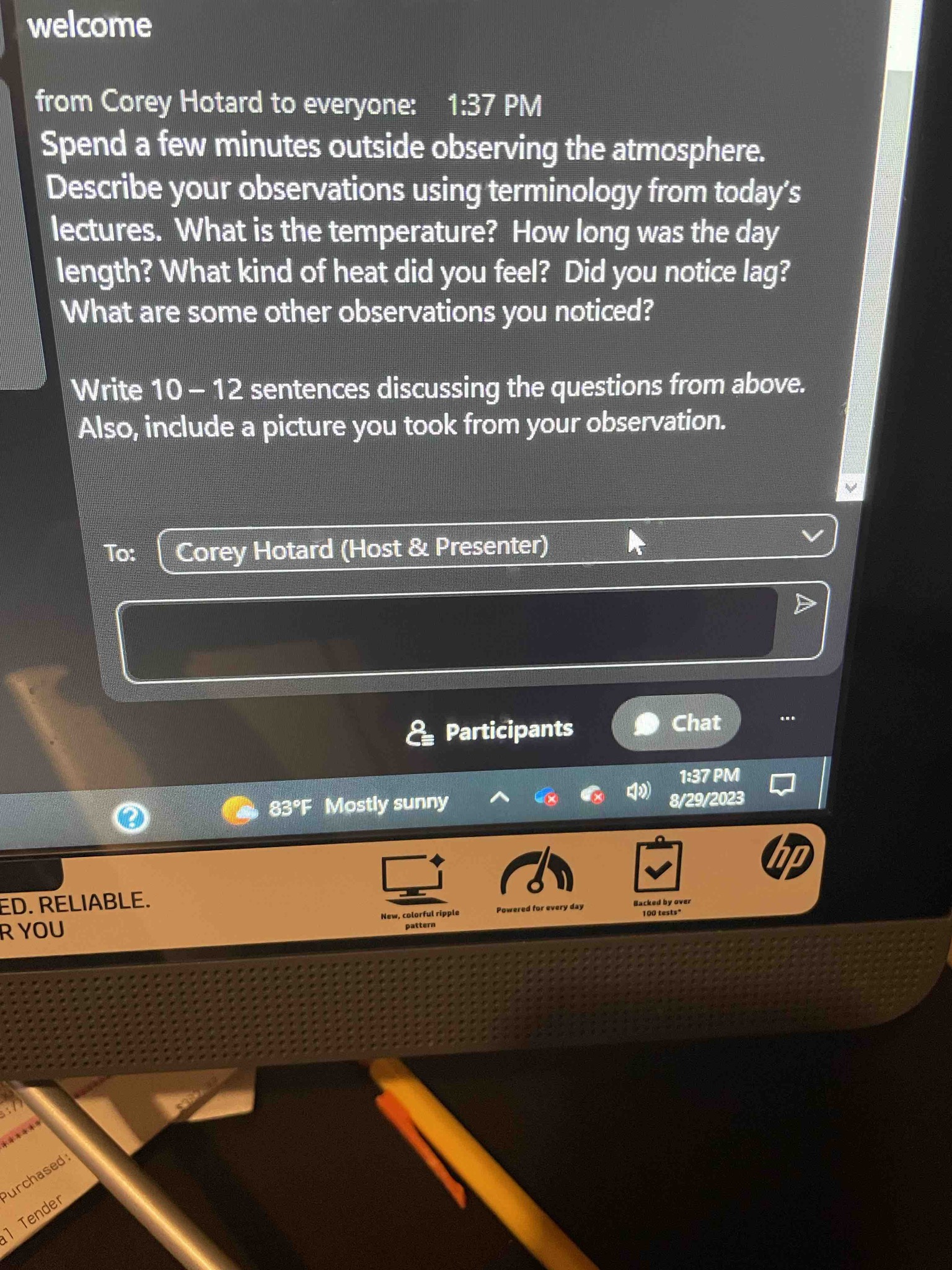
Spend a few minutes outside observing the atmosphere. Describe your observations using terminology from today's lectures. What is the temperature? How long was the day length? What kind of heat did you feel? Did you notice lag? What are some other observations you noticed? Write 10 - 12 sentences discussing the questions from above. Also, include a picture you took from your observation.
Answer
To fulfill this assignment, the student must integrate meteorological concepts with real-time observations. Based on the computer's taskbar showing 83°F and 'Mostly sunny' on August 29th, the student can start by noting that the air temperature is approximately 83°F, indicating high kinetic energy in the air molecules. The 'day length' refers to the photoperiod, which on August 29th would be roughly 13 hours and 30 minutes for lower latitudes, showing the gradual decrease as the autumnal equinox approaches. When discussing the 'kind of heat,' the student should distinguish between 'sensible heat' (the temperature they can physically feel through their skin via conduction or convection) and 'latent heat' (the energy involved in phase changes like sweat evaporating). The term 'lag' refers to the seasonal or daily thermal lag; in this case, the student might notice that although solar noon (maximum insolation) occurs around local noon, peak temperature typically occurs a few hours later, which is the daily temperature lag. For 'other observations,' they might mention the amount of insolation or the presence of scattered cumulus clouds characteristic of a 'mostly sunny' day. The final write-up should be 10-12 sentences long and synthesize these points to demonstrate an understanding of atmospheric energy transfer and temporal variations.