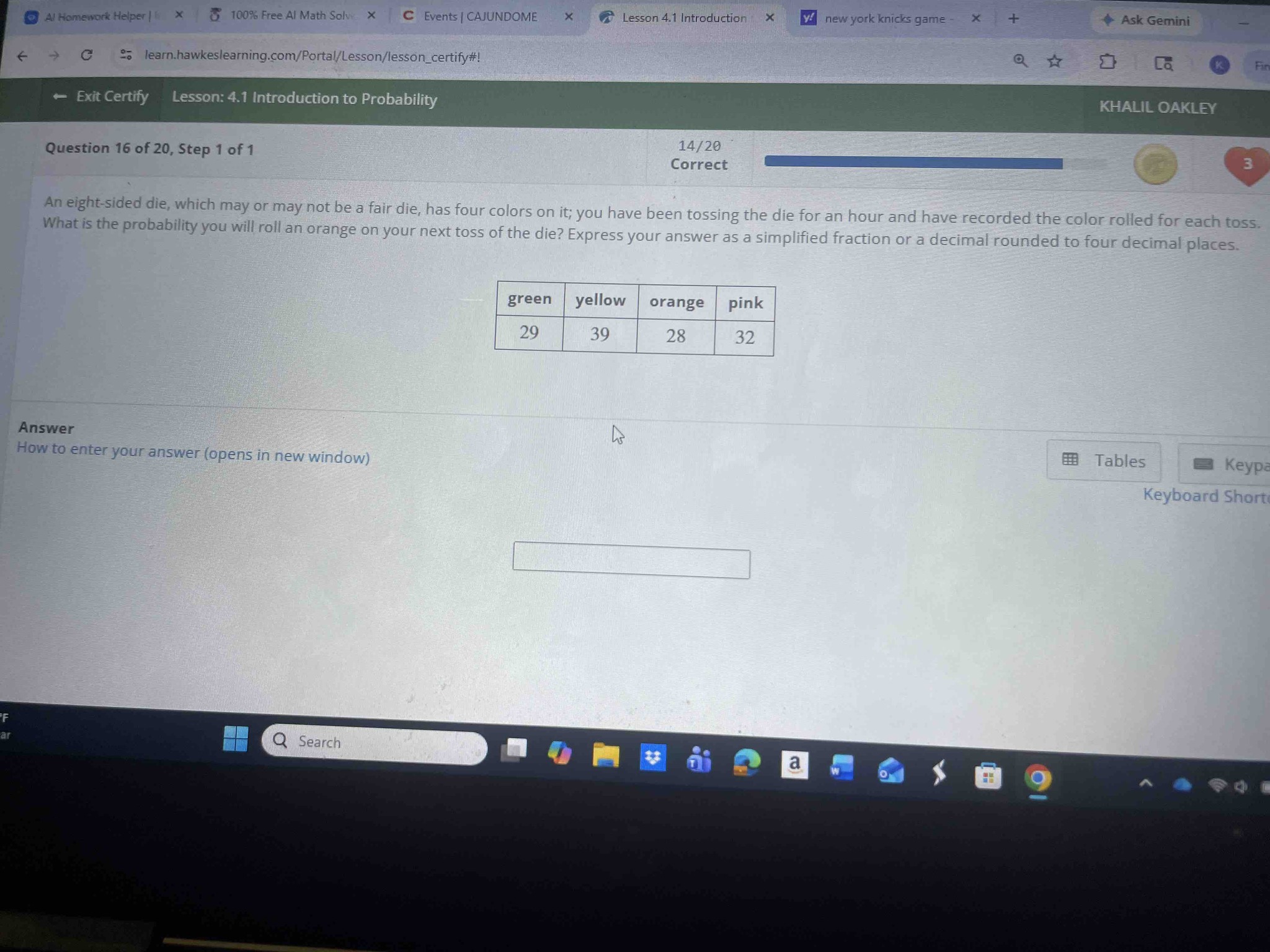
An eight-sided die, which may or may not be a fair die, has four colors on it; you have been tossing the die for an hour and have recorded the color rolled for each toss. What is the probability you will roll an orange on your next toss of the die? Express your answer as a simplified fraction or a decimal rounded to four decimal places. Data provided in table: green: 29, yellow: 39, orange: 28, pink: 32.
Answer
To find the empirical probability of rolling an orange, we must divide the frequency of orange rolls by the total number of rolls recorded. Step 1: Calculate the total number of rolls by summing the frequencies: 29 (green) + 39 (yellow) + 28 (orange) + 32 (pink) = 128 total rolls. Step 2: Identify the frequency for the target event, which is orange: 28. Step 3: Write the probability as a fraction: 28/128. Step 4: Simplify the fraction by dividing both the numerator and the denominator by their greatest common divisor, which is 4: 28 / 4 = 7 and 128 / 4 = 32. This gives the simplified fraction 7/32. Step 5: Convert to a decimal for a rounded answer: 7 / 32 = 0.21875. Rounding to four decimal places, we look at the fifth digit (5), which indicates we round up the fourth digit. Therefore, the decimal answer is 0.2188. Final Answer: 7/32 or 0.2188.