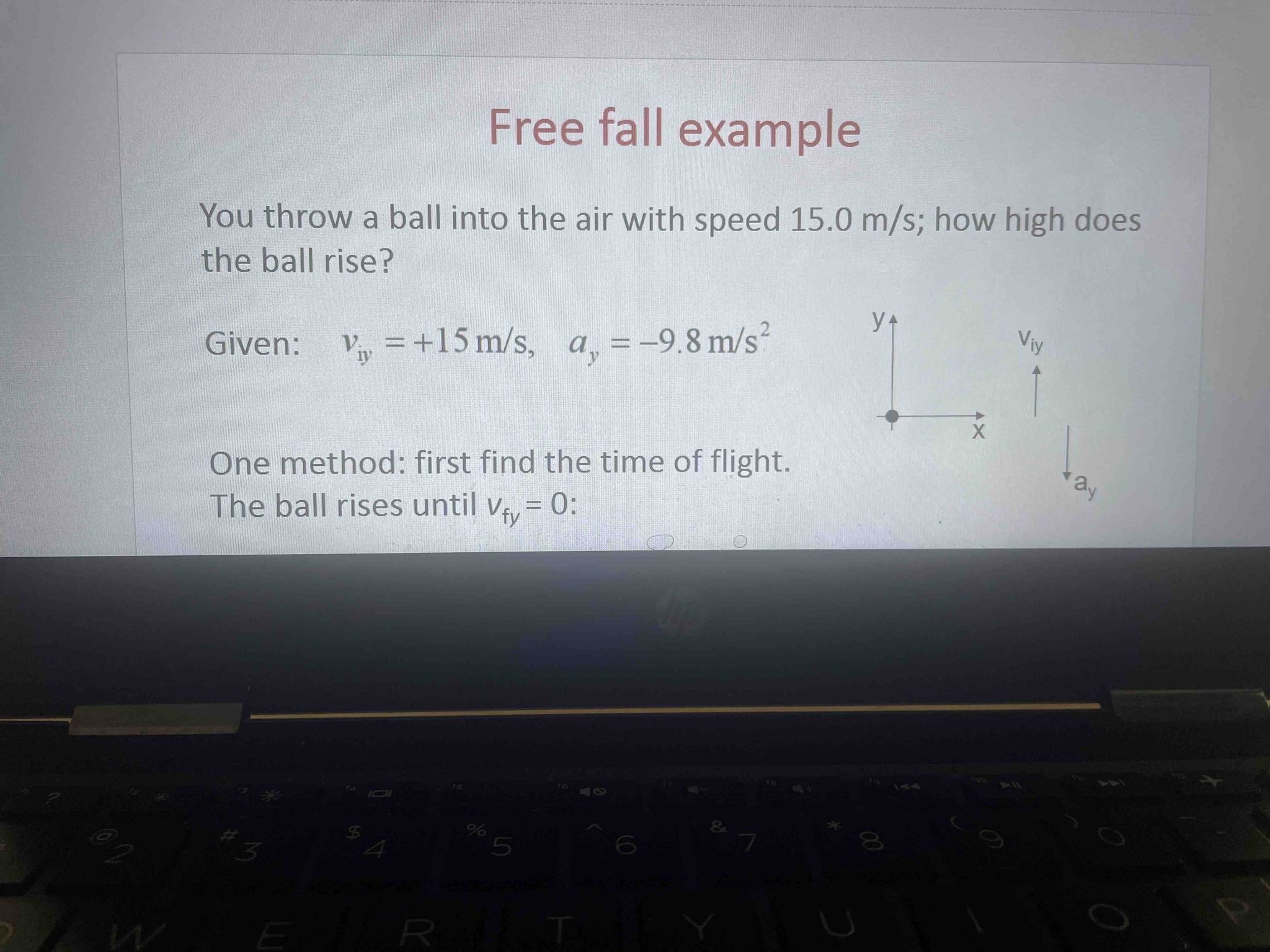
You throw a ball into the air with speed 15.0 m/s; how high does the ball rise? Given: v_iy = +15 m/s, a_y = -9.8 m/s^2.
Answer
To find how high the ball rises, we need to determine its displacement (delta y) when its velocity reaches zero at the peak of its trajectory. Step 1: Identify the known variables. The initial upward velocity (v_iy) is +15.0 m/s. The acceleration due to gravity (a_y or g) is -9.8 m/s^2. At the highest point, the final velocity (v_fy) is 0 m/s. Step 2: Use the kinematic equation that relates velocity, acceleration, and displacement: v_fy^2 = v_iy^2 + 2 * a_y * (delta y). Step 3: Rearrange the formula to solve for the displacement (delta y): (delta y) = (v_fy^2 - v_iy^2) / (2 * a_y). Step 4: Plug in the values: (delta y) = (0^2 - 15.0^2) / (2 * -9.8) = (-225) / (-19.6). Step 5: Calculate the final result: delta y = 11.47959... m. Rounding to significant figures based on the input '15.0', we get 11.5 meters. Alternatively, as suggested in the image, you can find the time first using v_fy = v_iy + a_y*t, which gives t = 1.53 s, and then plug that into delta y = v_iy*t + 0.5*a_y*t^2 to get the same result.