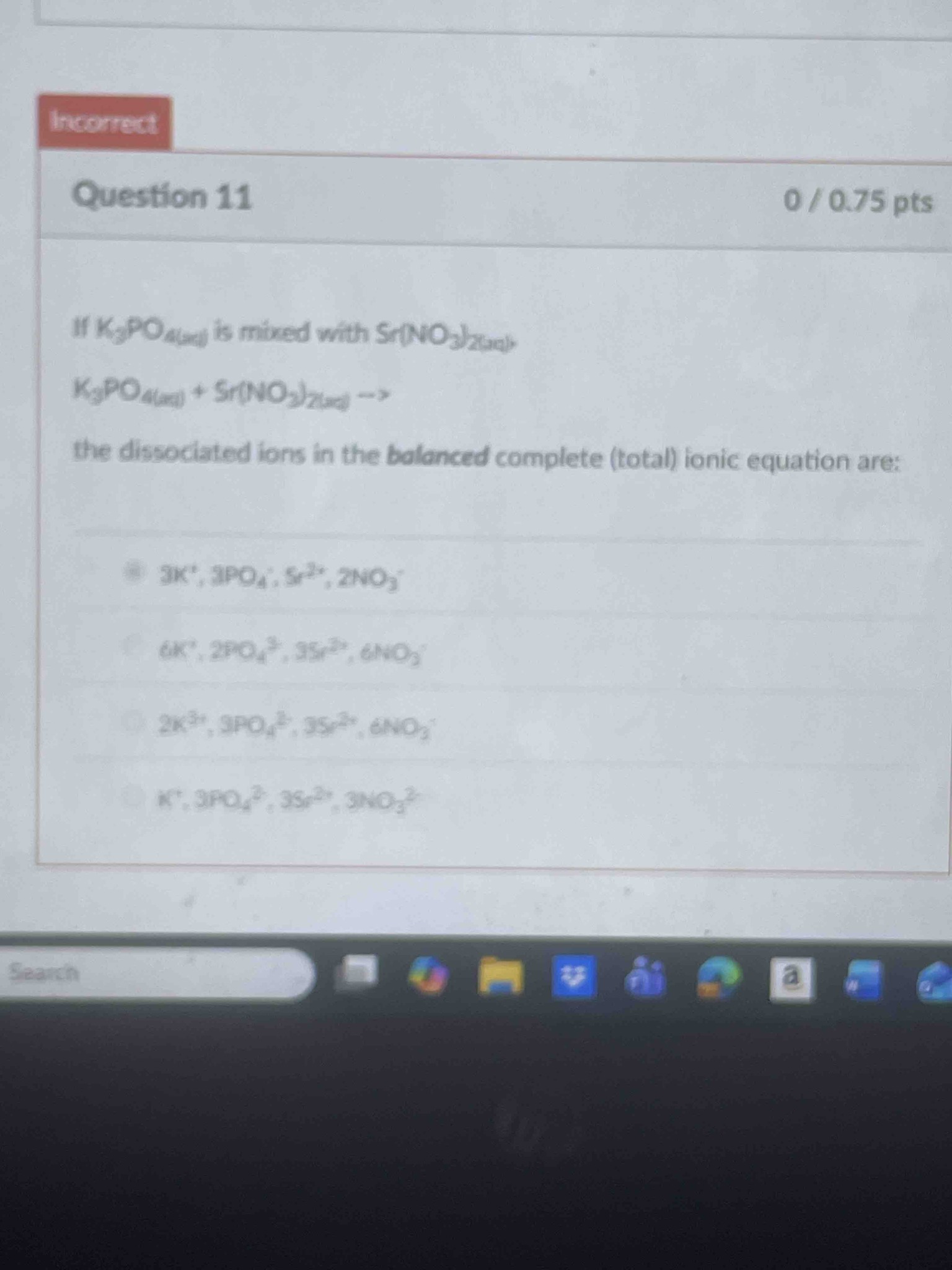
If K3PO4(aq) is mixed with Sr(NO3)2(aq), K3PO4(aq) + Sr(NO3)2(aq) -> the dissociated ions in the balanced complete (total) ionic equation are:
Answer
To find the dissociated ions in the balanced complete ionic equation, we must follow these steps: 1. Predict the products of the double displacement reaction. The products are Strontium Phosphate (Sr3(PO4)2) and Potassium Nitrate (KNO3). Based on solubility rules, Sr3(PO4)2 is a solid precipitate (s) and KNO3 is aqueous (aq). 2. Write the unbalanced molecular equation: K3PO4(aq) + Sr(NO3)2(aq) -> Sr3(PO4)2(s) + KNO3(aq). 3. Balance the molecular equation: To balance the Strontium, we need 3 Sr(NO3)2. To balance the Phosphate, we need 2 K3PO4. This gives us: 2K3PO4(aq) + 3Sr(NO3)2(aq) -> Sr3(PO4)2(s) + 6KNO3(aq). 4. Write the complete ionic equation by dissociating all aqueous (aq) substances into their constituent ions. Solids remain intact. 2 units of K3PO4 dissociate into 6K+(aq) and 2PO4^3-(aq). 3 units of Sr(NO3)2 dissociate into 3Sr^2+(aq) and 6NO3^-(aq). Therefore, the dissociated ions on the reactant side of the balanced complete ionic equation are: 6K+, 2PO4^3-, 3Sr^2+, 6NO3^-. This matches the second multiple-choice option.