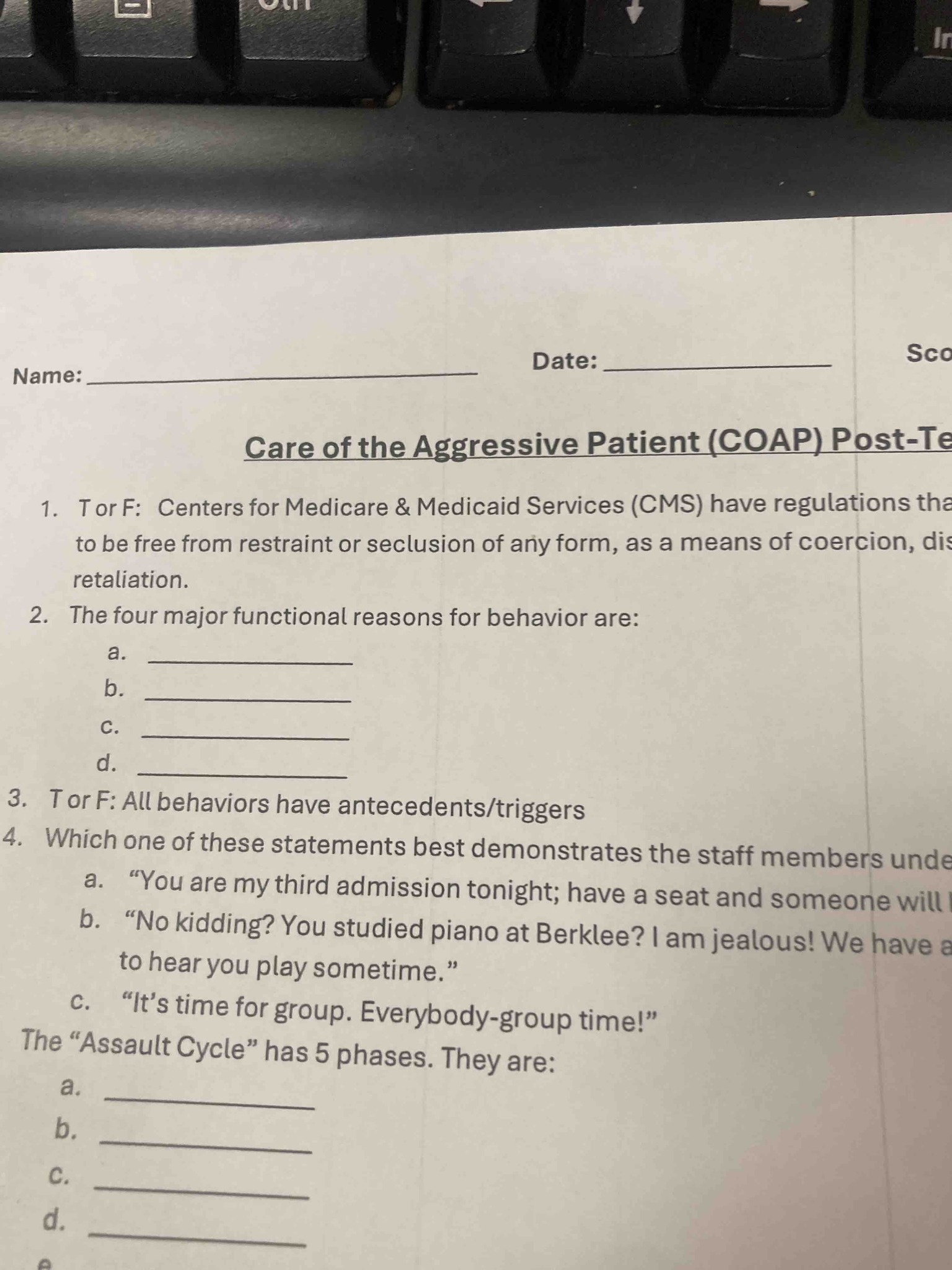
Care of the Aggressive Patient (COAP) Post-Te: 1. T or F: Centers for Medicare & Medicaid Services (CMS) have regulations that every individual has the right to be free from restraint or seclusion of any form, imposed as a means of coercion, discipline, convenience, or retaliation. 2. The four major functional reasons for behavior are: a. ____, b. ____, c. ____, d. ____. 3. T or F: All behaviors have antecedents/triggers. 4. Which one of these statements best demonstrates the staff members understanding... The 'Assault Cycle' has 5 phases. They are: a. ____, b. ____, c. ____, d. ____, e. ____.
Answer
1. True (T). CMS regulations guarantee that patients have the right to be free from restraints and seclusion used for coercion, discipline, convenience, or retaliation. 2. The four major functional reasons (functions) for behavior are typically: Sensory stimulation, Escape/Avoidance, Access to tangibles/attention (often referred to as SEAT: Sensory, Escape, Attention, Tangible). 3. True (T). Every behavior is preceded by an antecedent or trigger. 4. The five phases of the 'Assault Cycle' are typically: 1. Trigger, 2. Escalation, 3. Crisis, 4. Recovery, 5. Post-Crisis Depression (or Readjustment).