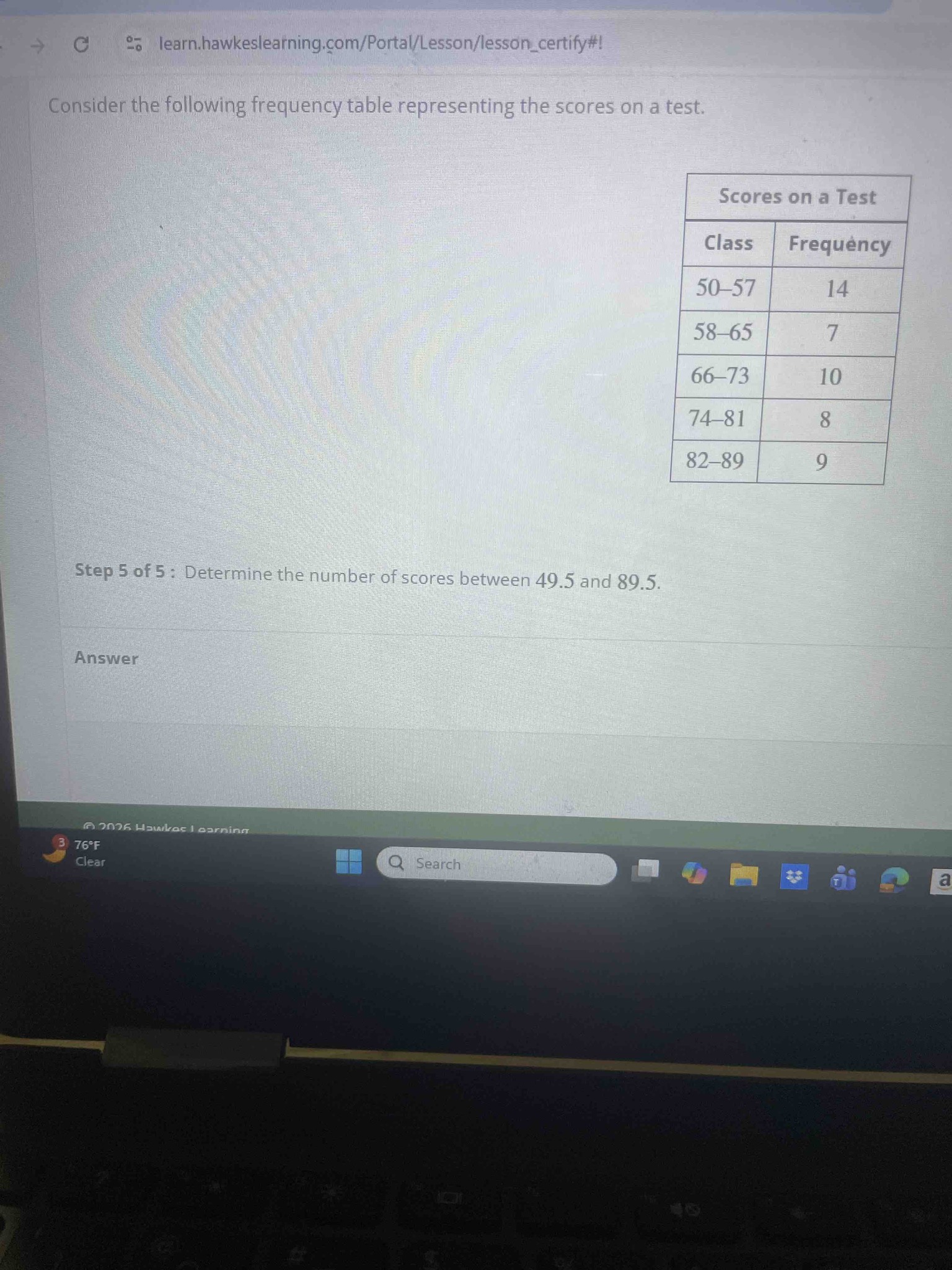
Consider the following frequency table representing the scores on a test. Class: 50-57 Frequency: 14; Class: 58-65 Frequency: 7; Class: 66-73 Frequency: 10; Class: 74-81 Frequency: 8; Class: 82-89 Frequency: 9. Step 5 of 5: Determine the number of scores between 49.5 and 89.5.
Answer
To find the number of scores between 49.5 and 89.5, we need to understand how class boundaries relate to the given class intervals. The class limits in the table are given as whole numbers. The class boundaries are typically defined as 0.5 below the lower limit and 0.5 above the upper limit to ensure there are no gaps between classes. Comparing the requested range (49.5 to 89.5) to the classes: 1. The lower boundary of the first class (50-57) is 50 - 0.5 = 49.5. 2. The upper boundary of the last class (82-89) is 89 + 0.5 = 89.5. Therefore, the range from 49.5 to 89.5 encompasses every single class listed in the frequency table. To find the total number of scores in this range, we simply sum the frequencies of all the classes: Sum = 14 (from 50-57) + 7 (from 58-65) + 10 (from 66-73) + 8 (from 74-81) + 9 (from 82-89). Calculating the sum: 14 + 7 + 10 + 8 + 9 = 48. The number of scores between 49.5 and 89.5 is 48.