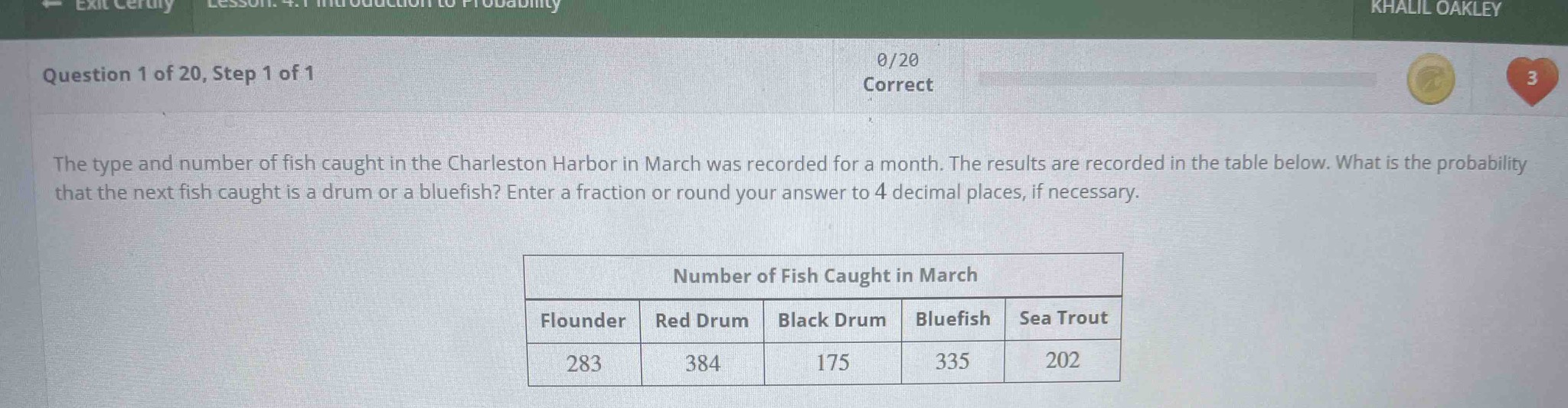
The type and number of fish caught in the Charleston Harbor in March was recorded for a month. The results are recorded in the table below. What is the probability that the next fish caught is a drum or a bluefish? Enter a fraction or round your answer to 4 decimal places, if necessary. Table data: Flounder (283), Red Drum (384), Black Drum (175), Bluefish (335), Sea Trout (202).
Answer
To find the probability that the next fish caught is a drum or a bluefish, we first need to calculate the total number of fish caught in the sample. Total = 283 (Flounder) + 384 (Red Drum) + 175 (Black Drum) + 335 (Bluefish) + 202 (Sea Trout) = 1379. Next, we identify the categories that satisfy the condition 'a drum or a bluefish'. This includes Red Drum, Black Drum, and Bluefish. Sum of these categories = 384 + 175 + 335 = 894. The empirical probability is the ratio of favorable outcomes to the total outcomes: P(drum or bluefish) = 894 / 1379. As a decimal rounded to 4 places, 894 / 1379 is approximately 0.6483.