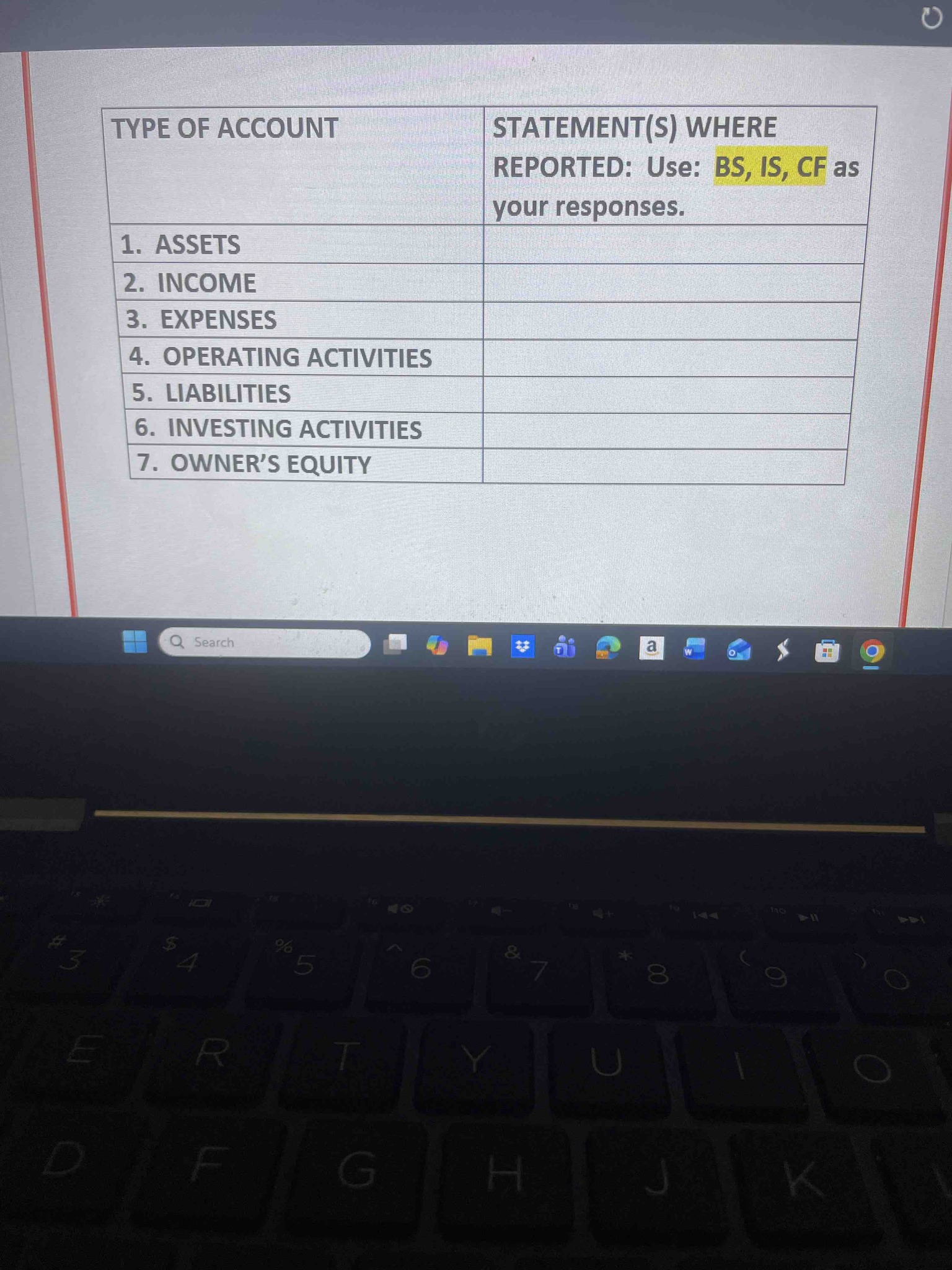
For each TYPE OF ACCOUNT listed in the table, identify the STATEMENT(S) WHERE REPORTED using the abbreviations BS (Balance Sheet), IS (Income Statement), and CF (Statement of Cash Flows). The accounts are: 1. ASSETS, 2. INCOME, 3. EXPENSES, 4. OPERATING ACTIVITIES, 5. LIABILITIES, 6. INVESTING ACTIVITIES, 7. OWNER'S EQUITY.
Answer
The classification of accounts to financial statements is based on fundamental accounting principles. Here is the detailed breakdown: 1. ASSETS: Reported on the BS (Balance Sheet). Assets represent resources owned by a business at a specific point in time. 2. INCOME: Reported on the IS (Income Statement). Income (or Revenue) measures the earnings generated by business operations over a period. 3. EXPENSES: Reported on the IS (Income Statement). Expenses represent the costs incurred to generate revenue during a period. 4. OPERATING ACTIVITIES: Reported on the CF (Statement of Cash Flows). This section specifically details cash inflows and outflows from core business operations. 5. LIABILITIES: Reported on the BS (Balance Sheet). Liabilities represent obligations or debts the business owes to outside parties. 6. INVESTING ACTIVITIES: Reported on the CF (Statement of Cash Flows). This section tracks cash movements related to the purchase or sale of long-term assets. 7. OWNER'S EQUITY: Reported on the BS (Balance Sheet). Owner's equity represents the residual interest in the assets of the entity after deducting liabilities.