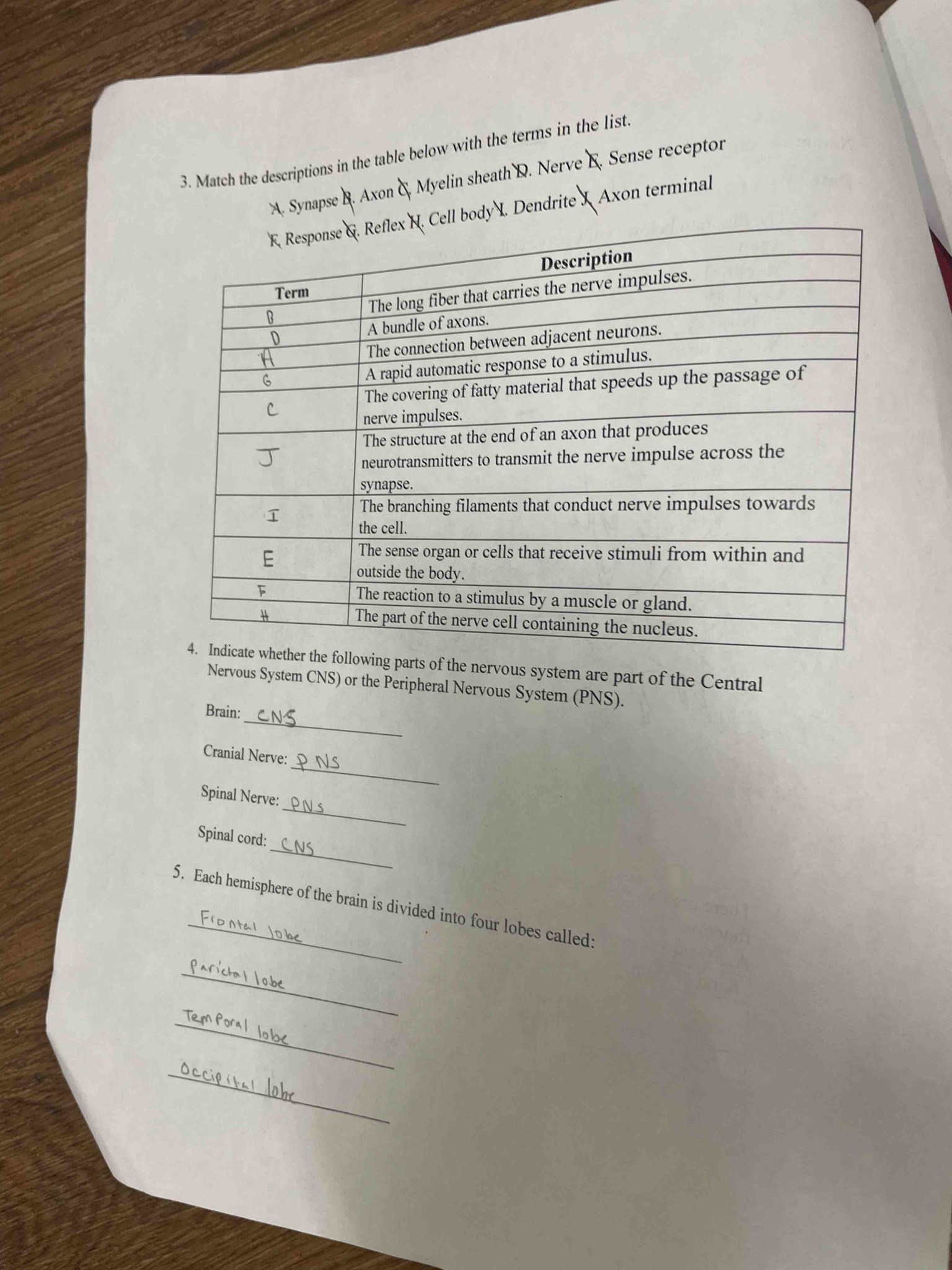
The image contains three questions related to the nervous system: 3. Match the descriptions in the table with the terms in the list (Synapse, Axon, Myelin sheath, Nerve, Sense receptor, Response, Reflex, Cell body, Dendrite, Axon terminal). 4. Indicate whether parts of the nervous system (Brain, Cranial Nerve, Spinal Nerve, Spinal cord) are part of the Central Nervous System (CNS) or the Peripheral Nervous System (PNS). 5. Name the four lobes that each hemisphere of the brain is divided into.
Answer
For question 3, the matching is as follows: The long fiber that carries the nerve impulses is the Axon (B). A bundle of axons is a Nerve (D). The connection between adjacent neurons is a Synapse (A). A rapid automatic response to a stimulus is a Reflex (G). The covering of fatty material that speeds up impulses is the Myelin sheath (C). The structure at the end of an axon that produces neurotransmitters is the Axon terminal (J). Branching filaments that conduct impulses towards the cell are Dendrites (I). Sense organ or cells that receive stimuli are Sense receptors (E). The reaction to a stimulus by a muscle or gland is a Response (F). The part of the nerve cell containing the nucleus is the Cell body (H). For question 4: The Brain and Spinal cord are part of the Central Nervous System (CNS), while Cranial Nerves and Spinal Nerves are part of the Peripheral Nervous System (PNS). For question 5: Each hemisphere of the brain is divided into the Frontal lobe, Parietal lobe, Temporal lobe, and Occipital lobe.