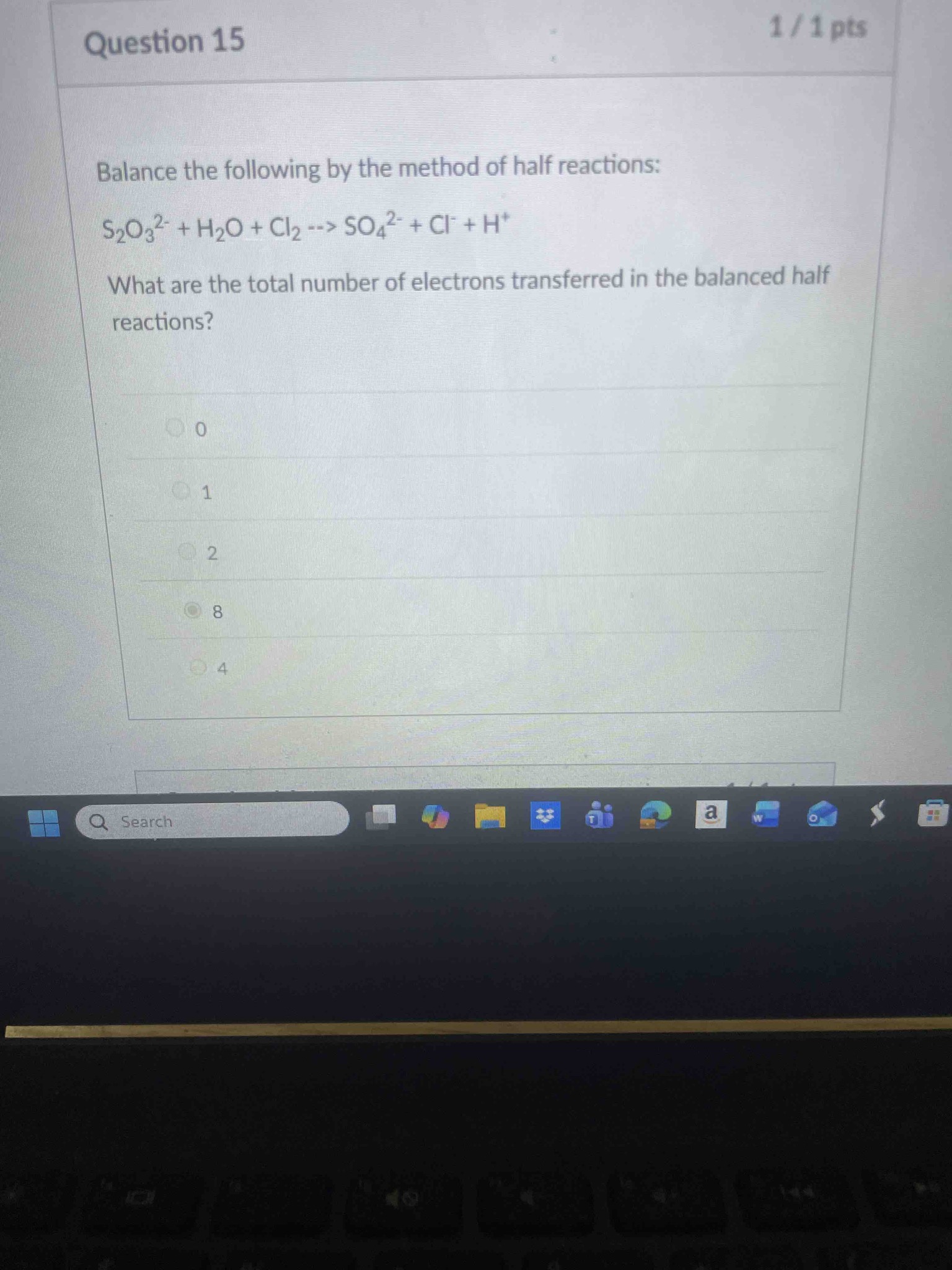
Balance the following by the method of half reactions: S2O3^2- + H2O + Cl2 --> SO4^2- + Cl- + H+. What are the total number of electrons transferred in the balanced half reactions?
Answer
Step 1: Identify the oxidation and reduction half-reactions. 1) Oxidation: S2O3^2- -> SO4^2-. Sulfur undergoes oxidation. In S2O3^2-, the oxidation state of sulfur is +2. In SO4^2-, it is +6. 2) Reduction: Cl2 -> Cl-. Chlorine undergoes reduction from an oxidation state of 0 to -1. Step 2: Balance each half-reaction. For oxidation (S2O3^2- -> 2SO4^2-): Balance S atoms by adding a coefficient of 2 to SO4^2-. Next, balance O atoms by adding 5H2O to the left side: S2O3^2- + 5H2O -> 2SO4^2-. Then balance H atoms by adding 10H+ to the right side: S2O3^2- + 5H2O -> 2SO4^2- + 10H+. Finally, balance charge by adding electrons. The left side is -2, and the right side is (-4 + 10) = +6. Adding 8 electrons to the right balances the charge: S2O3^2- + 5H2O -> 2SO4^2- + 10H+ + 8e-. For reduction (Cl2 -> 2Cl-): Balance Cl atoms by adding a coefficient of 2 to Cl-. Balance charge by adding 2 electrons to the left: Cl2 + 2e- -> 2Cl-. Step 3: Equalize the number of electrons. The oxidation reaction transfers 8 electrons. The reduction reaction transfers 2 electrons. To make them equal, multiply the reduction reaction by 4: 4(Cl2 + 2e- -> 2Cl-) which becomes 4Cl2 + 8e- -> 8Cl-. Thus, the total number of electrons transferred in the balanced half-reactions is 8.