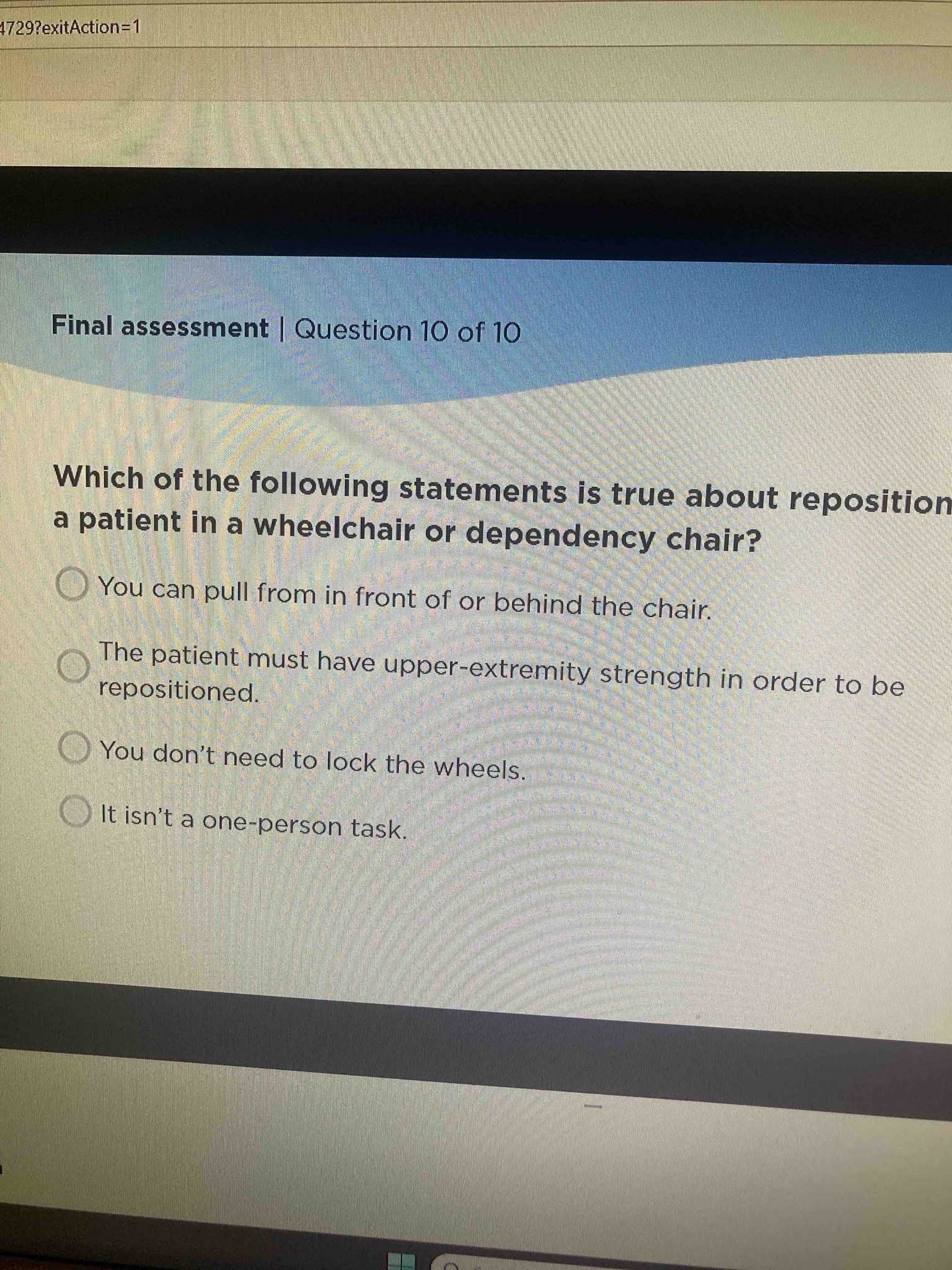
Which of the following statements is true about repositioning a patient in a wheelchair or dependency chair?
Answer
When repositioning a patient in a wheelchair or dependency chair, safety protocols must be followed to prevent falls and injury. The correct standard practice is ensuring the wheels of the wheelchair are locked during the transfer or repositioning process (making 'You don't need to lock the wheels' false). Pulling a patient from in front or behind incorrectly can cause injury; healthcare staff are generally trained to avoid pulling and instead use proper lifting and sliding techniques, often requiring assistance depending on the patient's condition, but it is not universally a two-person task if specific assistive devices or proper training allow, yet the safest true statement regarding basic mechanical safety during care involves locking the wheels. However, evaluating the remaining statements: patients do not need upper-extremity strength (they can be completely dependent); pulling from in front is discouraged due to strain; and repositioning can often be a one-person task with appropriate technique. Therefore, carefully reviewing safety guidelines, locking the wheels is a fundamental safety step, though depending on specific facility protocols, the intended answer relates to proper technique and safety measures. Let us re-evaluate the options: 1. You can pull from in front of or behind the chair (false, pulling causes shearing and friction injuries). 2. The patient must have upper-extremity strength in order to be repositioned (false, dependent patients are repositioned often). 3. You don't need to lock the wheels (false, wheels must always be locked). 4. It isn't a one-person task (depending on the patient's weight and mobility, it often requires two people to reposition safely without causing injury to the caregiver or patient, making this the most appropriate safety-oriented statement among the common misconceptions).