HW Helper

Download on App Store
Directions: Using the list of common prefixes in Table 1, write the meaning of each of the following boldfaced words. If you are unfamiliar with the root, check its meaning in a dictionary.
1. a multinational corporation
2. antisocial behavior
3. inefficient study habits
4. postglacial period
5. unspecialized training
6. housing subdivision

Directions: Using the list of common prefixes in Table 1, write the meaning of each of the following boldfaced words. If...

what is SD FOR TV. LETTER A GRADE AT THE END

what is SD FOR TV. LETTER A GRADE AT THE END

REFLECTION ACTIVITY: HOW WAS THIS CLASS? Reflect on the following questions in 2-4 sentences each: What do you think the purpose is of requiring all students to take English classes? Do you feel like you have become comfortable in writing for all '3 purposes of writing' and creating arguments around all '4 types of claims'? Do you feel comfortable writing all kinds of genres to all kinds of audiences? Do you feel comfortable relying on EITHER personal analysis and common knowledge OR researched, credible sources? Do you feel the course has prepared you to think of all writing as a recursive, collaborative PROCESS? What tasks did we complete in our section specifically that you found useful or memorable? OR through what kind of lessons, assignments, or essays did you learn those skills?

REFLECTION ACTIVITY: HOW WAS THIS CLASS? Reflect on the following questions in 2-4 sentences each: What do you think the...

REFLECTION ACTIVITY: In 2-4 sentences each, reflect on the following questions. 1: HOW WAS THIS CLASS? (Includes sub-questions about the purpose of English classes, comfort with purposes of writing/types of claims, genres/audiences, sources, writing as a recursive process, and memorable tasks). 2: HOW WAS PAPER 1? (Includes sub-questions about feelings on the Argumentative Proposal Letter prompt, the timeline of the writing process, feedback received, and strengths/struggles/personal challenges).

REFLECTION ACTIVITY: In 2-4 sentences each, reflect on the following questions. 1: HOW WAS THIS CLASS? (Includes sub-que...

Is it safe to eat food that has freezer burn?

Is it safe to eat food that has freezer burn?

What is the weight of the heaviest person in the range 150 to 159 inclusive?

What is the weight of the heaviest person in the range 150 to 159 inclusive?

How many people weigh in the range from 130 to 180 inclusive?

How many people weigh in the range from 130 to 180 inclusive?

The following stem-and-leaf plot represents the distribution of weights for a group of people. Step 1 of 3 : What is the weight of the lightest person in the group?

The following stem-and-leaf plot represents the distribution of weights for a group of people. Step 1 of 3 : What is the...

Find the percentage of students that scored higher than 70.5. Round your answer to the nearest percent.

Find the percentage of students that scored higher than 70.5. Round your answer to the nearest percent.

Step 4 of 5: Find the number of students that took this exam.

Step 4 of 5: Find the number of students that took this exam.

Step 3 of 5: Find the class width for this histogram.

Step 3 of 5: Find the class width for this histogram.

Step 2 of 5 : Find the upper class limit of the fourth class. Assume the scores are whole numbers.
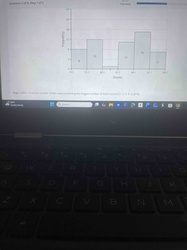
Step 2 of 5 : Find the upper class limit of the fourth class. Assume the scores are whole numbers.

Step 1 of 5: Find the number of the class containing the largest number of exam scores (1, 2, 3, 4, 5, or 6).
Step 1 of 5: Find the number of the class containing the largest number of exam scores (1, 2, 3, 4, 5, or 6).

What is the letter grade for a score of 17/21?
What is the letter grade for a score of 17/21?

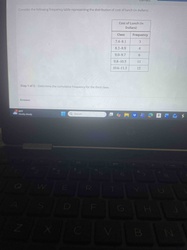
Consider the following frequency table representing the distribution of cost of lunch (in dollars). Table: Class 7.4-8.1 (Frequency 3), 8.2-8.9 (Frequency 4), 9.0-9.7 (Frequency 6), 9.8-10.5 (Frequency 11), 10.6-11.3 (Frequency 12). Step 1 of 2: Determine the cumulative frequency for the third class.

Consider the following frequency table representing the distribution of cost of lunch (in dollars). Table: Class 7.4-8.1...
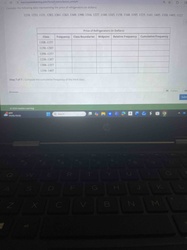
Consider the following data representing the price of refrigerators (in dollars): 1218, 1253, 1121, 1282, 1261, 1263, 1349, 1390, 1316, 1227, 1140, 1245, 1158, 1168, 1195, 1225, 1161, 1405, 1320, 1405, 1122. Step 7 of 7: Compute the cumulative frequency of the third class.

Consider the following data representing the price of refrigerators (in dollars): 1218, 1253, 1121, 1282, 1261, 1263, 13...
Consider the following data representing the price of refrigerators (in dollars): 1218, 1253, 1121, 1282, 1261, 1263, 1349, 1390, 1316, 1227, 1140, 1245, 1158, 1168, 1195, 1225, 1161, 1405, 1320, 1405, 1122. Step 6 of 7: Calculate the relative frequency of the third class. Determine your answer as a simplified fraction.

Consider the following data representing the price of refrigerators (in dollars): 1218, 1253, 1121, 1282, 1261, 1263, 13...
Step 5 of 7: Identify the midpoint of the fifth class.
Step 5 of 7: Identify the midpoint of the fifth class.

Consider the following data representing the price of refrigerators (in dollars): 1218, 1253, 1121, 1282, 1261, 1263, 1349, 1390, 1316, 1227, 1140, 1245, 1158, 1168, 1195, 1225, 1161, 1405, 1320, 1405, 1122. Step 4 of 7: Determine the upper class boundary for the fourth class.

Consider the following data representing the price of refrigerators (in dollars): 1218, 1253, 1121, 1282, 1261, 1263, 13...
Step 3 of 7: Determine the lower class boundary for the fourth class.
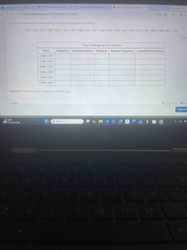
Step 3 of 7: Determine the lower class boundary for the fourth class.

Consider the following data representing the price of refrigerators (in dollars): 1218, 1253, 1121, 1282, 1261, 1263, 1349, 1390, 1316, 1227, 1140, 1245, 1158, 1168, 1195, 1225, 1161, 1405, 1320, 1405, 1122. Step 2 of 7: Determine the frequency of the fifth class.

Consider the following data representing the price of refrigerators (in dollars): 1218, 1253, 1121, 1282, 1261, 1263, 13...
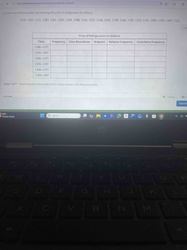
Consider the following data representing the price of refrigerators (in dollars): 1218, 1253, 1121, 1282, 1261, 1263, 1349, 1390, 1316, 1227, 1140, 1245, 1158, 1168, 1195, 1225, 1161, 1405, 1320, 1405, 1122. Step 1 of 7: Determine the class width of the classes listed in the frequency table. The classes provided are: 1108–1157, 1158–1207, 1208–1257, 1258–1307, 1308–1357, 1358–1407.

Consider the following data representing the price of refrigerators (in dollars): 1218, 1253, 1121, 1282, 1261, 1263, 13...
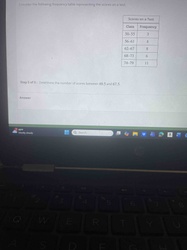
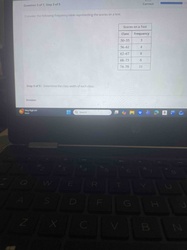
Consider the following frequency table representing the scores on a test. Class: 50-55, Frequency: 3; Class: 56-61, Frequency: 4; Class: 62-67, Frequency: 8; Class: 68-73, Frequency: 6; Class: 74-79, Frequency: 11. Determine the number of scores between 49.5 and 67.5.

Consider the following frequency table representing the scores on a test. Class: 50-55, Frequency: 3; Class: 56-61, Freq...
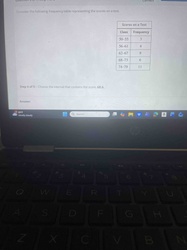
Consider the following frequency table representing the scores on a test.

| Class | Frequency |
|-------|-----------|
| 50-55 | 3 |
| 56-61 | 4 |
| 62-67 | 8 |
| 68-73 | 6 |
| 74-79 | 11 |

Step 4 of 5: Choose the interval that contains the score, 68.6.

Consider the following frequency table representing the scores on a test. | Class | Frequency | |-------|-----------| |...
Consider the following frequency table representing the scores on a test. Step 3 of 5 : Determine the class width of each class. The classes provided are: 50-55, 56-61, 62-67, 68-73, and 74-79.

Consider the following frequency table representing the scores on a test. Step 3 of 5 : Determine the class width of eac...
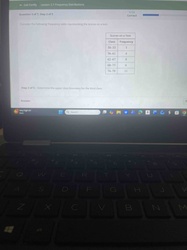
Consider the following frequency table representing the scores on a test. Scores on a Test - Class: 50–55 (Frequency: 3), 56–61 (Frequency: 4), 62–67 (Frequency: 8), 68–73 (Frequency: 6), 74–79 (Frequency: 11). Step 2 of 5: Determine the upper class boundary for the third class.

Consider the following frequency table representing the scores on a test. Scores on a Test - Class: 50–55 (Frequency: 3)...
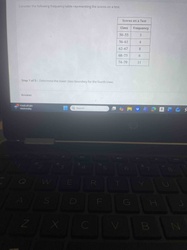
Consider the following frequency table representing the scores on a test. The table includes five classes: 50-55 (frequency 3), 56-61 (frequency 4), 62-67 (frequency 8), 68-73 (frequency 6), and 74-79 (frequency 11). Step 1 of 5: Determine the lower class boundary for the fourth class.

Consider the following frequency table representing the scores on a test. The table includes five classes: 50-55 (freque...
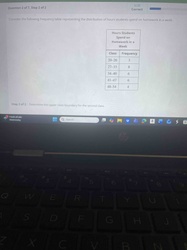
Consider the following frequency table representing the distribution of hours students spend on homework in a week. Determine the upper class boundary for the second class. 

Table Data:
- Class 20-26, Frequency 3
- Class 27-33, Frequency 8
- Class 34-40, Frequency 6
- Class 41-47, Frequency 6
- Class 48-54, Frequency 4

Consider the following frequency table representing the distribution of hours students spend on homework in a week. Dete...
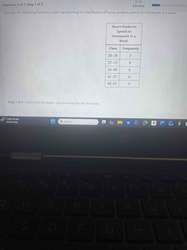
Consider the following frequency table representing the distribution of hours students spend on homework in a week. Determine the lower class boundary for the first class.

Consider the following frequency table representing the distribution of hours students spend on homework in a week. Dete...
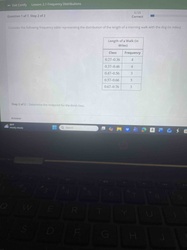
Consider the following frequency table representing the distribution of the length of a morning walk with the dog (in miles). Determine the midpoint for the third class.

Consider the following frequency table representing the distribution of the length of a morning walk with the dog (in mi...
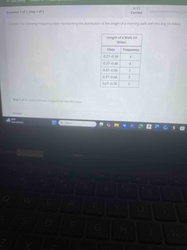
Consider the following frequency table representing the distribution of the length of a morning walk with the dog (in miles). Determine the midpoint for the fifth class.

Consider the following frequency table representing the distribution of the length of a morning walk with the dog (in mi...
Determine whether the statement describes a descriptive or inferential statistic. A survey of 1040 people revealed that 60% are self-conscious about their weight; therefore it can be assumed that 60% of the U.S. population are self-conscious about their weight.

Determine whether the statement describes a descriptive or inferential statistic. A survey of 1040 people revealed that ...
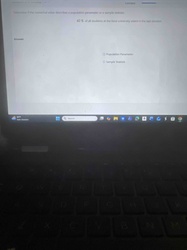
Determine if the numerical value describes a population parameter or a sample statistic. "62% of all students at the local university voted in the last election"

Determine if the numerical value describes a population parameter or a sample statistic. "62% of all students at the loc...
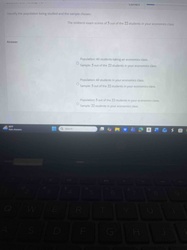
Identify the population being studied and the sample chosen for the following scenario: The midterm exam scores of 5 out of the 22 students in your economics class.

Identify the population being studied and the sample chosen for the following scenario: The midterm exam scores of 5 out...
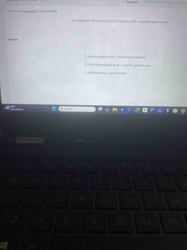
Identify the population being studied. Scenario: The heights of 14 out of the 27 okra plants at Mr. Lonardo's greenhouse. Options: 1) All okra plants at Mr. Lonardo's greenhouse. 2) The 14 okra plants at Mr. Lonardo's greenhouse. 3) All okra plants in greenhouses.

Identify the population being studied. Scenario: The heights of 14 out of the 27 okra plants at Mr. Lonardo's greenhouse...
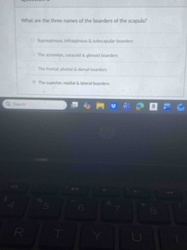
What are the three names of the boarders of the scapula?
What are the three names of the boarders of the scapula?

Which of the following is/are not component(s) of the pelvic girdle? A. sacrum B. Femurs C. Hip bones D. Coxal bones
Which of the following is/are not component(s) of the pelvic girdle? A. sacrum B. Femurs C. Hip bones D. Coxal bones

The appendicular skeleton consist of the parts that protects the head, neck & trunk?
The appendicular skeleton consist of the parts that protects the head, neck & trunk?

Which of the following describes the clavicle?
Which of the following describes the clavicle?

Atlas is one of the ______________ vertebrae. 
Options:
Thoracic
Sacral
Cervical
Lumbar
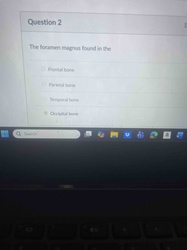
Atlas is one of the ______________ vertebrae. Options: Thoracic Sacral Cervical Lumbar

The foramen magnus found in the: Frontal bone, Parietal bone, Temporal bone, Occipital bone
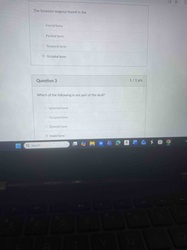
The foramen magnus found in the: Frontal bone, Parietal bone, Temporal bone, Occipital bone

Which of the following is not part of the skull? 
- Sphenoid bone 
- Occipital bone 
- Ethmoid bone 
- Hyoid bone

Which of the following is not part of the skull? - Sphenoid bone - Occipital bone - Ethmoid bone - Hyoid bone

← 3456 →
Privacy PolicyTerms of Service